
One of the themes most commonly cited by the marketers I’ve interviewed for both Boring2Brave and OrbitalX’s Do More With Less podcast is a lack of inspiring role models within B2B marketing.
Matthew Robinson, former VP Marketing at Contentsquare and now founder at B2B Three, told me: ‘For role models I often find myself looking outside of B2B marketing. Maybe that says something quite worrying about us as a discipline.’
Maybe. Or perhaps we needn’t regret needing to look elsewhere for genius to motivate us.
Creativity and inspiration aren’t battery farmed. They’re entirely free range.
Our brains are not so regimented that we can only be inspired by role models who mirror the jobs we do or the fields we work in. Anything that makes you feel energised or stirs your thinking is surely legitimate.
I have a lifetime obsession with The Beatles. I’ll assume you’re familiar with them, though not for their B2B marketing chops. My mother grew up with them in Liverpool in the 1950s and 60s. I inherited her passion.
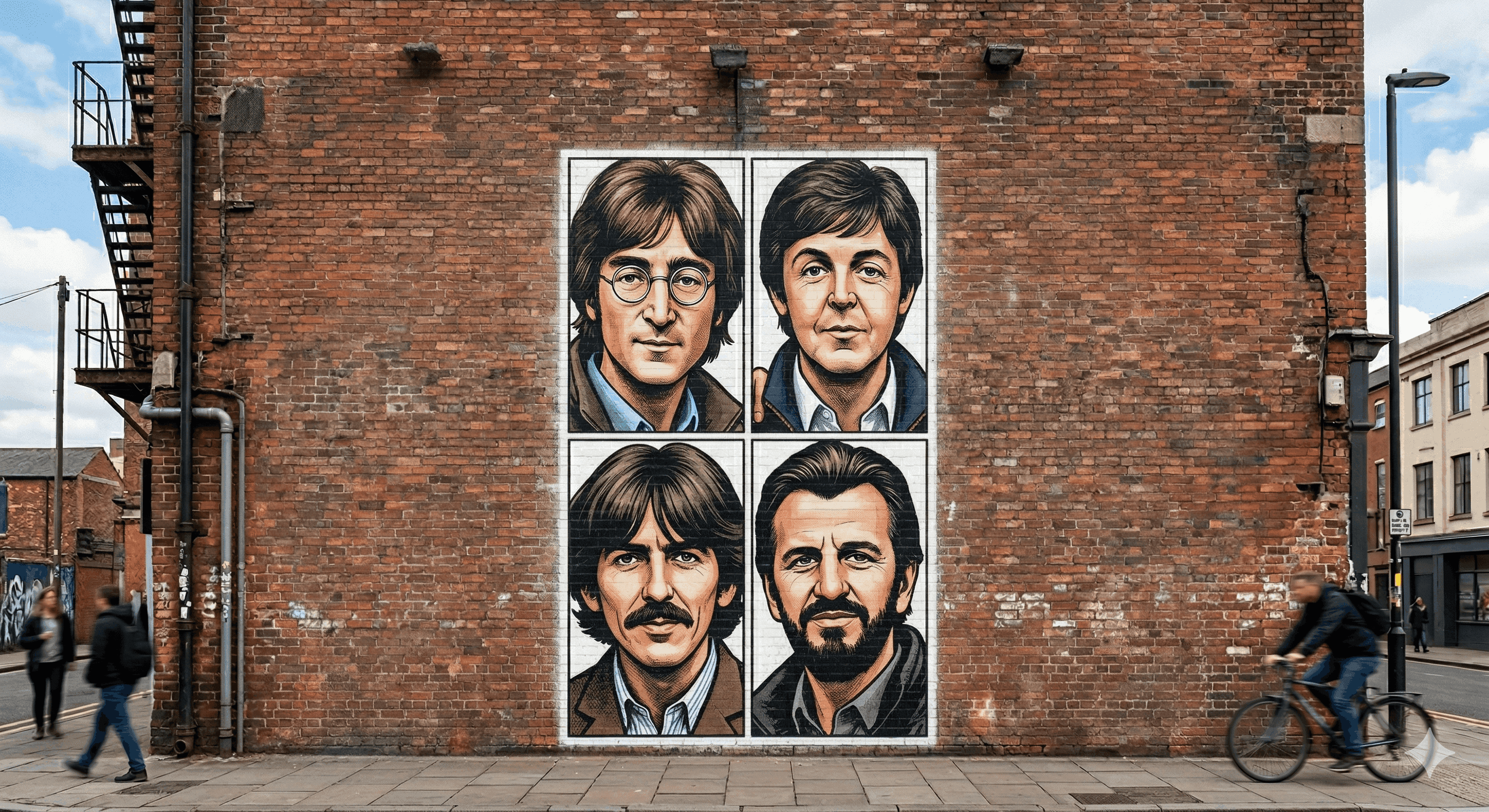
John, Paul, George and Ringo would have made for brilliant B2B marketers if they hadn’t been so busy. Here are 14 reasons why.
1. They perfectly combined the latest tech with talent
The Beatles constantly set the template for innovation in the recording studio; not just in songwriting and performance but in pushing their producers and engineers to get more out of the studio tech than previously thought possible. They loved technology. As recently as November 2023, the Beatles’ unique use of AI enabled their last ever single, Now and Then. The song, which was finalized using AI technology to enhance John Lennon's voice from an old demo, was hailed as a historic, record-breaking return and became their 18th UK chart-topper.
Learning: Race to the bleeding edge of tech and push it further; but you’ll still need talent.
2. They were dogged about creating original content
The band made an early decision to write their own songs at a time when it just wasn’t the done thing for recording artists.
Learning: Deciding from the outset to make originality your benchmark reaps you disproportionate benefits. It forces you to become an ideas factory.
3. If you do steal, make it count
When The Beatles did steal other people’s content, they didn’t just pay tribute to what were often obscure rhythm & blues tracks. They added youth, energy, speed and urgency to turn them into iconic Beatles standards. Twist and Shout wasn’t a Beatles original. They made it theirs.
Learning: How you transform old ideas with a fresh take will tell your market everything it needs to know about your sense of conviction, purpose and energy.
4. They worked to be that good
The Beatles made themselves qualified. They practised hard; we’re talking Malcolm Gladwell’s ‘ten thousand hours’ and more. In an era when apprenticeship was a common route into work, The Beatles made five trips to Hamburg between 1960 and 1962, playing for up to eight hours a night, seven days a week.
Learning: There’s really only one way to become as good as you want them to think you are. Work for it.
5. They overcame obstacles
Two of the band turned their own self-perceived shortcomings into a competitive advantage.
George and Paul were instinctively and conventionally gifted on their instruments. John, though, had an innate rhythm all his own and was often questioned about the quality of his guitar playing. He didn’t even consider himself that good. He knew his strengths and played to them.
‘I’m OK,’ John told Rolling Stone about his guitar playing in 1971. ‘I’m not technically good, but I can make the guitar fucking howl and move. If you sat me with B. B. King, I’d feel silly. I’m embarrassed about my playing in one way because it’s very poor, but I can make a guitar speak. I can make a band drive.’
Similarly, Ringo’s drumming was unique. Being a left-handed drummer on a right-handed kit gave his playing a rare quality because he led with his ‘wrong hand’. But he also innovated ‘underneath’ the more vaunted work of his colleagues with drum parts all of his own. Fans commonly cite the song Rain as an example of his uncommon talent. A listen to any one of She Said She Said on the Revolver album, Come Together from Abbey Road, Ticket to Ride from Help, A Day in the Life from Sgt Pepper’s Lonely Hearts Club Band or, Strawberry Fields Forever, would also highlight why Ringo was the other Beatles’ only choice as drummer.
Learning: You possess a trait that others will define as a weakness. It’s not a weakness; it’s a distinction. Turn it to your advantage.
6. They knew their competitors
When you have to beat the Stones and the Beach Boys to be the best, it pushes you to insane heights. In 1966, The Stones recorded Paint It Black and the album Aftermath, which included Under My Thumb, Out of Time and Mother’s Little Helper. The same year, the Beach Boys released Wouldn’t It Be Nice and Sloop John B on the album Pet Sounds. The Beatles released Paperback Writer, Eleanor Rigby and (in the US) Nowhere Man as singles and produced the Revolver album. All this dazzling output was partly driven by these bands trying to outdo one another. By contrast, in 1966 Manchester group The Hollies – inconceivably part of the same scene in the same era – released singles Bus Stop and Stop, Stop, Stop; a tedious pair of e-book equivalents.
Learning: Find yourself a worthy competitor. Recognise and celebrate its quality internally with your team. It will spur you on.
7. They understood ‘multi-channel’
The Beatles created content of the highest possible standard. Some 50 years later, young children know and sing their songs. Word for word. Imagine anything you write being quoted, cited or performed five decades from now.
And they were multi-channel marketers. They recorded songs, wrote books, produced feature-length films, performed live panto on theatre stages, drew sketches and experimented with photography.
They could make any format their own – as compelling a band in a cramped, sweaty basement in Liverpool as they were in front of a 55,000-strong audience at the home of Major League Baseball team the Mets in New York City.
Learning: B2B marketing needn’t be restricted to the same boring channels and formats with which we’re all so familiar. Here’s a brief: what combination of message and media would have people citing your work in 50 years’ time?
8. They were storytellers
For four young men with a level of status and wealth that separated them from most, The Beatles retained an instinctive attachment to the humdrum lives of ‘normal’ people. Headlines in the Daily Mirror and Daily Mail respectively inspired the colourful poignancy of She’s Leaving Home and A Day in the Life.
Elsewhere, a diverse set of characters – sometimes hilarious, other times violent or lonely – contained in the likes of Eleanor Rigby, Penny Lane, Norwegian Wood (This Bird Has Flown), Ob-la-di Ob-la-da, Lovely Rita, Polythene Pam and I Am the Walrus are now laced permanently throughout the British psyche and culture.
Learning: Use stories to create a world outside of your products and promotions. People attach to stories in ways they don’t to a sales pitch.
9. The Beatles innovated wildly but their brand remained constant
The Beatles are the most ‘branded’ musical artist ever. Thousands of bands and artists have a widely recognised, unmistakable sound, look and feel but The Beatles were brand masters. In their short time as a group, they changed everything possible about their product and their image: from leather-clad teens, to suited and booted national treasure; to drug- experimenting mid-sixties popstars; to Yellow Submarine movie cartoon characters; to long-haired rock aristocracy and an often madcap beyond, including John and wife Yoko conducting interviews with the world’s press from inside a bag. The Beatles were constantly on the move.
But you’d recognise every one of their looks. If I say ‘Beatle haircut’, ‘Beatle boots’ or ‘Beatle collarless jackets’, you likely have the same image in your head as I have. You can identify the band just from their silhouette on a fridge magnet.
The Beatles’ brand was multi-layered and complex; there is a branded universe of mythology and music – broad enough for Beatles lovers of all ages and tastes to find something to feast upon.
Learning: Your brand is more than your ‘look and feel’; your logo and colour palette for example. It’s far more about what you represent to your customers. As long as it holds true to the brand values or distinct positioning you offer to your community, you can experiment as much as you want with formats, colours and channel strategy.
10. Their authenticity connected them more strongly to their fans
The Beatles dug deep inside themselves and their own experiences for their inspiration. The music and lyrics of Penny Lane, Strawberry Fields Forever, Help, In My Life and I’m a Loser (with its refrain of ‘I’m not what I appear to be’) were among their most personal and self- aware tracks.
Learning: Often, the deeper you look inside yourself and your experience to find ‘real’ stimulus for your content, the more it’s likely to connect with your audience.
11. The Beatles were brave
The Beatles were unafraid to be themselves. Though courted by the establishment, they were unconcerned by supposed social hierarchies or authority and refused to adhere to other people’s ‘nonsense’ rules.
At various times they spoke openly (and often controversially) on their drug use, on religion and on the nonsense hype of celebrity where, if they were playing the ‘PR game’ right, they may have remained silent.
They refused to play to racially segregated audiences in the US in towns like Jacksonville, Florida, even though they knew their decision would confuse or anger many Americans.
Untrained in the media, they stared down or made fun of stupid questions at press conferences. Old TV footage shows that when one of them gave an answer that could be deemed controversial, none of the bandmates flinched or even, at times, looked up. They trusted and backed each other to be honest and straight-talking. When you’ve got that kind of support from colleagues, it breeds the strength to be you, without unnecessary PR gloss.
Learning: Your audience is sophisticated and can smell glitzy PR polish on you a mile off. PR is useful to a point but not when it gets in the way of you being real, honest and interesting.
12. They continued to invent; even after failing
As recording artists, The Beatles stretched the possible. They featured backwards guitar on I’m Only Sleeping and recorded a George Martin electric piano solo at half-speed before playing the tape back at double speed to create an entirely different sound on In My Life.
Importantly, they weren’t deterred when risks didn’t come off. The surreal Magical Mystery Tour movie in 1967 was a critical flop but it didn’t stop them stretching their imaginations again two years later, to create the Yellow Submarine film.
Learning: Exploring and taking risks appeal to our human need for advancement. If nothing else, taking a risk to try something new gets you remembered.
13. They were great at both briefing and selling in ideas
The Beatles pushed through the barriers of a four-piece rock band and, hence, needed outsiders to help them create their records. That meant harnessing the skills of strangers. Paul said of the big orchestra crescendo on A Day in the Life:
“We told the orchestra – ‘you’ve got fifteen bars, all you’ve gotta do is start on whatever is the lowest note on your instrument and by the time the end of those 15 bars has arrived, you’ve got to be on the top note on your instrument – we don’t mind how you get there.’”
“I had to keep going around explaining it to everyone, ‘it’s a silly idea I know, but bear with us, it will work out, don’t worry’...”
Learning: Selling in a vision or idea’ is not a ‘one-time’ job. Don’t stop telling everyone how it’s going to work and what the result will look like. People have doubts and fears. They can be cynical. If it’s your idea, you’ve got to be the leader.
14. They got results
The Beatles didn’t just sell records by the million. They changed the world. They scared the establishment. They influenced culture. They created teenagers. They triggered mania. Their fans and stories will outlast all of them, as will their product.
Learning: Your role is to do great marketing. Your job is to help grow the company and sell product. Your ‘results’? What you’ll be known and remembered for by ‘the end’? Well, that’s up to you.