Browse the Latest Stories and Insights

Browse the Latest Stories and Insights

Thoughtful articles, breakdowns, and perspectives from across the industry - all in one place.

All
Leadership
AI
Content and Communications
Career
ABM
Demand Generation
MarTech
Fractional Marketing
All
Leadership
AI
Content and Communications
Career
ABM
Demand Generation
MarTech
Fractional Marketing
Picture of Nigel

A CEO’s Guide to What Really Matters in B2B Marketing

As a CEO, many CMOs are effectively chasing your attention. When they invest heavily in ultimate guides and thought leadership content, what do they need to do differently to get you to engage?

It’s got to be relevant and it’s got to be accessible. I do download content fairly often, but I don’t tend to download massive documents - I just don’t have the time. Time is critical.

I prefer what I’d describe as snackable content. I think a lot of people are overwhelmed by the volume of information out there and we’re all short on time. Most PDFs end up in my “to read” folder and then never actually get read.

The issue isn’t necessarily the insight, it’s the format it’s delivered in. I prefer fast, accessible content: videos, podcasts, short pieces that I can consume easily.

There are exceptions. There are a couple of documents I read every year because they’re directly relevant to the business challenges I’m facing. But fundamentally there’s just a lot out there, so content needs to be targeted, relevant, and consumable.

Many B2B marketing teams would say they already tick those boxes. Is that enough?

There is a lot of repetitive content out there. You only have to look at how many articles are being published on AI, they’re often saying the same things and delivered in the same way.

If content tackled issues in a slightly different way, or was delivered in a more engaging or distinctive format, that would definitely get my attention. Right now, a lot of it looks and sounds the same.

Is content consumption always “on” for you, or are there moments when you actively seek things out?

Personally, I like reading and taking on content. If I’m dealing with a specific business challenge, I’ll actively go out and find solutions to that problem. I’ll ignore a lot of content that feels generic or irrelevant, but when I need to dig into something, I’ll seek it out.

You’ve held senior GTM roles across major organisations. When you look at a marketing dashboard, what’s the metric you care most about and which ones do you have no time for?

The metric I care about most is marketing-sourced pipeline, but it needs to be real pipeline. Opportunities that are actionable and can turn into revenue.

Marketing-attributed revenue is another key one. A single number that shows whether marketing is genuinely helping grow the business.

Those metrics aren’t always available straight away because they rely on good data, systems, and workflows. That data might come from the website, events, inbound enquiries — wherever. But that’s what I want to see.

Vanity metrics, on the other hand, things that look good on dashboards but don’t translate into revenue,  are less helpful. Page impressions, generic page views, follower counts: they matter, but they don’t tell me whether we’re generating qualified demand or revenue.

You’re also a practicing artist. Has creativity influenced your approach to marketing?

I’ve been painting pretty much all my life. I wanted to go to art college originally, but my dad encouraged me to get what he called a “proper degree”.

A few years ago I had some downtime and got back into my artwork. We have a place in Cornwall, and I started creating sea-life-inspired pieces in a pop-art style. A gallery there picked them up and began exhibiting them.

So yes, creativity has always been part of who I am.

How does that creative side show up in your marketing philosophy, particularly around brand versus performance?

Brand awareness is vitally important. It doesn’t always translate immediately into revenue metrics, but being known for something,  what you’re good at, what you stand for,  really matters.

That said, particularly in tougher times, you have to stay focused on growth and revenue. Some marketing metrics simply don’t add value when you’re trying to understand how the business is actually performing.

So it’s about balance. Brand supports long-term growth, but it has to sit alongside clear commercial outcomes.

If a downturn hits and budgets need to be cut quickly, where do you start?

I wouldn’t start by cutting marketing. It’s counterintuitive. You can’t cut your way out of trouble, you have to grow your way out.

Marketing is a lever for growth, not a discretionary cost. I’d look elsewhere first: vendor consolidation, travel, back-office duplication, non-core projects.

In one organisation I worked in, we had around 800 internal projects running at once, many solving the same problems in different ways across regions. We shut most of them down and replaced them with a smaller number of consistent initiatives. The cost savings were significant.

If marketing cuts are unavoidable, it should be about reallocation, not elimination. Dial back experimental activity, but protect channels that reliably generate demand; account-based marketing, targeted industry events, proven performance channels.

You’ve written about the productivity paradox. Are marketers over-tooled?

Yes, I think there are too many tools in most organisations, and that adds complexity. Individually the tools are fine, but collectively - especially in global organisations - they create friction, and friction reduces productivity.

I’ve worked in businesses operating across 30 countries, each with its own CRM system, analytics tools, and implementations. That fragmentation adds cost and slows everything down.

There are huge savings and productivity gains to be made through consolidation. There are dozens of platforms- HubSpot, Salesforce, Marketo, Pardot, Mailchimp, Hootsuite and many more - all doing similar things.

Reducing the number of tools and standardising how they’re used is absolutely key.


Watch the full interview on the B2B Marketing United YouTube channel.

Feb 9, 2026

5 min read

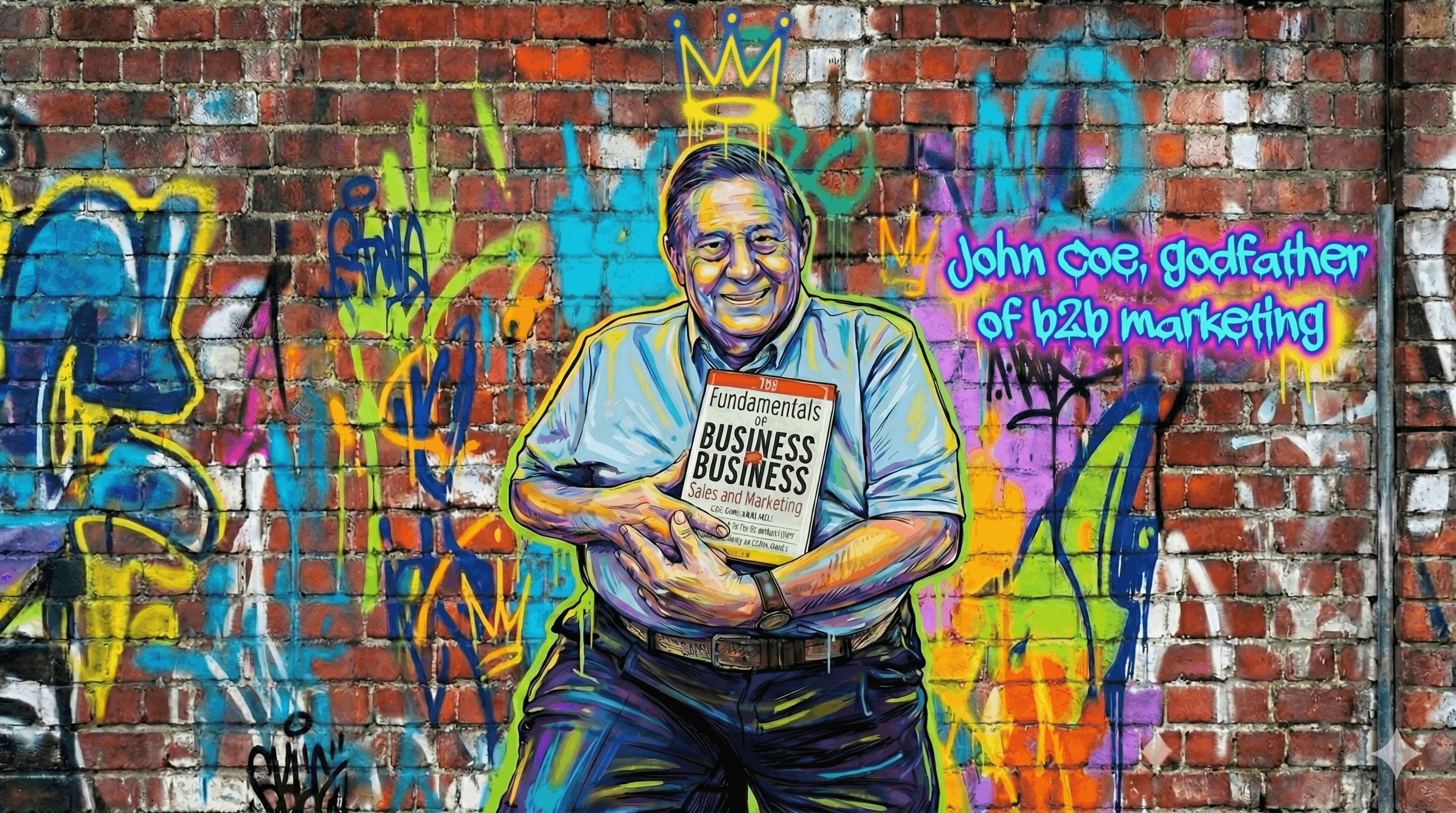
Image of john Coe

The Godfather of B2B Marketing on Sales, Trust and Why Fundamentals Still Win

Often described as the Godfather and one of the true forefathers of B2B marketing, it’s an honour to speak with you today. You’ve famously talked about speaking from “both sides of your mouth” - can you explain what that means for B2B marketers, and why having both perspectives really matters?

Well, I started my career in sales and spent quite a bit of time in sales and sales management. Then, according to my friends in sales, I went to the dark side and moved into marketing, primarily because of lead generation. That’s a long story.

But the fact of the matter is, I think any marketer in B2B needs to either have been in sales or really understand sales. The old phrase “walk a mile in my shoes” really applies here - it equips marketers to do a better job.

For B2B marketers who haven’t had the opportunity to work in sales - do you have any advice on how marketers can at least empathise with and understand that world?

That’s a good question. When I get a new client, one of the first things I ask is whether I can travel with their salespeople for a day or two - and not just one salesperson. I like to spend time with two or three.

What I find is that within the first half-day, they’re suspicious of me. But once they realise I understand sales, they open up. And when they do, the gems that come out of their mouths are incredible and hugely valuable for future marketing efforts.

You’ve got to get that trust right, and that empathy means they see you as a friend, not a foe.

And John, taking that thought further, your book The Fundamentals of B2B Sales and Marketing - there’s a clue in the title. You’ve developed a new sales coverage model. Is that a useful framework for marketers looking to build empathy and understanding with sales?

First, I should say not all situations are the same. Selling office furniture is very different from selling a machine tool that has to be designed. You need to define what you’re selling before you can design a coverage model that makes sense.

Do you use distributors or not? Does your coverage model rely on face-to-face interaction as a primary channel? Coverage models vary based on what you’re selling and who you’re selling to.

For example, in manufacturing, you’re often selling to engineers, not purchasing agents. These two factors drive very different coverage models.

That’s a great point. We talk a lot today about group marketing, where marketers need to engage multiple roles within large organisations, each with different interests in the product or service, and adapt messaging accordingly.

That’s what’s now called account-based marketing, and I completely agree with it. Even when I was in sales years ago, I did things people didn’t expect. I’d talk to purchasing, but I’d also go to the plant and speak with production scheduling. As a result, we often exceeded what the contract originally allowed.

If you’re selling to enterprise accounts, there can be five, ten, or more people involved in the decision. Marketers need to understand who they’re communicating with and that communication isn’t one-size-fits-all.

Exactly. And John, am I right in thinking that there was a version of ABM in 1980 -  it just wasn’t called ABM back then.

Yes, back then it was called Strategic Account Management.

Today, B2B marketing is one of the fastest-growing industries in the developed world. What did you see all those years ago that made you register b2bmarketing.com? What told you this was coming?

It wasn’t so much what I saw, it was what I experienced. At the time, people were underestimating the size of the B2B market. 

Think about a car. You buy one consumer product, but behind that car are 100 to 200 B2B suppliers. People focused on the consumer product and ignored the massive B2B ecosystem behind it.

I saw that because I came from sales. When I moved into marketing, many people had never worked in sales and underestimated both the size and potential of the market. Eventually, that changed and that’s why B2B has grown the way it has.

What has surprised you most about the rapid growth of B2B marketing?

One major surprise over the last five to ten years has been the explosion of technology. I’m an old face-to-face guy, and now there are nearly 14,000 software packages in sales and marketing.

The issue is that people adopt technology and forget the fundamentals. They hope technology will fix their problems, generate leads, build relationships, but without fundamentals, that’s a mistake.

Young marketers love tech. Older ones like me worry about fundamentals being lost.

That balance is fascinating. Technology has brought choice, but also choice paralysis. With AI now dominating the conversation, have the fundamentals of B2B marketing actually changed?

One thing that hasn’t changed is the emotional side of B2B buying. I’m writing a report on this now. We make emotional decisions first,  trust,  before we justify them with facts.

B2B marketing has historically ignored this emotional element, even though purchase decisions often involve significant personal and career risk.

Exactly. Buying a cheap personal item is one thing. Buying something expensive at work means spending someone else’s money,  and that’s emotional.

Take a CRM system. Choosing or changing one can be career-ending if it goes wrong. Yet most marketing ignores that risk and emotional trust requirement.

And we’re back to buying groups again - different roles, different concerns, same product.

Correct. Purchasing, finance, users, sales managers - each has different needs and trust factors. Messaging must be relevant to each.

Do you remember the first time you heard the phrase “B2B marketing”?

It came from a creative director at an agency I worked with in New York. In 1997, she shortened “business to business” to B2B, and it stuck. When I registered b2bmarketing.com, that’s where it came from.

Last century! 

It was. And it resonated.

Before you go, one final question on AI and data decay. Is there a risk that AI compounds bad data?

Absolutely. AI can help,  even with updating CRMs, but data changes rapidly. In a room of 100 managers, around 70% will have had at least one change to their role or company in the past year. If you don’t stay on top of that, you’re communicating with people who aren’t there anymore.

Zombie communication?

Exactly. Great output requires great input.

John, thank you so much for joining us and for decades of contribution to B2B marketing as the Godfather.

Thank you -  and remember, the Godfather always has an offer you can’t refuse.

Watch the full interview on the B2B Marketing United YouTube channel.

Feb 9, 2026

6 min read

Jake bird mural

Busting the Myths Around AI in Marketing: An interview with Jake Bird

You’ve been working in AI for around three years now, and a lot seems to have changed in that time. We’ve gone from marketers trying to understand what AI even is, to claims that it’s now “embedded” everywhere. What’s the reality - myth or maturity?

I don’t think it’s embedded at all. The stat I saw recently was that fewer than 5% of organisations have embedded AI effectively. There’s so much misinformation online and a lot of hype. There are a lot of vibes around what AI can do.

The reality is you can’t just give people these tools and expect good work back. They don’t work like that. The people who get the most value have spent a lot of time understanding how the technology works and testing it.

Where we are now is the proper implementation phase. That means technology, infrastructure, and change management. It takes time for people to get used to using these tools. It’s a new way of working and it signals a new wave of marketing.

Many organisations feel pressure to “get AI” without knowing where to start. What tools would you actually recommend for marketers beginning this journey?

The tools I personally get the most value from are Claude, as a strategic partner and for content creation. Perplexity, which is excellent for research - that’s what it’s built for. Gemini, where Google has really stepped up in the last six months with 2.5 Pro and their broader suite. Those three are a strong starting point.

And what should marketers avoid?

This might be a hot take, but I’m cautious about anything labelled as an agent in marketing.

An agent is essentially another layer of software sitting on top of a large language model. A true agent makes decisions autonomously, without a human in the loop. In marketing, that strips out innovation and nuance.

Because these models are predictive they guess what comes next - agentic AI risks accelerating more of the same ideas instead of creating new ones. In other disciplines, agents can work well. But in marketing, creativity matters.

Do you think marketers are ready to use multiple LLMs for different purposes?

It took me about four years of curiosity to get to the point where I can confidently move between tools. Each one has different quirks and behaviours.

GPT is more subservient, it does what you tell it. Claude is more inquisitive and asks better questions. But getting comfortable takes time and curiosity. Most marketers aren’t there yet.

There’s also a tendency to focus purely on content. Should AI be doing more than that?

Absolutely. Content shouldn’t be the sole purpose of AI. It should be workflows and processes.

From a business perspective, the first question shouldn’t be “what tools should we use?” but “what value are we trying to create?” Every business is different. AI should support an objective, not exist for its own sake.

Are organizations actually seeing ROI when AI is implemented properly?

Yes, when it’s done well. Businesses using AI effectively are cutting acquisition costs by around 50% and improving revenue by 10–15%. That can mean a 20–30% increase in ROI.

But that only happens when AI is used as an extension of the team, not a replacement. Too many companies took the “cheap” route last year: giving everyone ChatGPT and hoping for the best. That’s not actually cheap when you factor in wasted time and poor outputs.

There’s also confusion between individual AI use and enterprise-level AI. How big a problem is that?

It’s huge. AI has been treated as a catch-all. There’s personal AI, helping individuals with ideation, decks, analysis and then there’s technical AI, the actual builds and systems. They’ve been lumped together as if AI can magically solve everything.

That oversimplification causes a lot of frustration.

Looking ahead, where should marketers actually be experimenting next?

My advice is simple: try every task with AI first and assess the output. Even when it doesn’t work, you learn something.

I’m sceptical about AI-generated video and voice. They often feel dishonest and are easy to spot. I don’t mind people being transparent about using AI as long as there’s human oversight.

What excites me more is predictive AI: spotting where markets are heading, identifying emerging interests, and shaping messaging or even products proactively rather than reactively.

Many teams are already “bringing their own AI” into organisations. What should CMOs do about governance?

If you block AI entirely, people will just use it anyway  and that’s riskier. Without training and governance, you lose control completely.

I know plenty of people who pay for their own AI subscriptions because their company won’t allow it. They work faster and get better results but without oversight.

The better approach is enablement with guardrails.

Final question: will roles like “prompt engineer” or “Head of AI” still exist in a year?

I think we’ll still see Heads of AI, but not prompt engineers. Prompting will become business as usual.

Watch the full interview on the B2B Marketing United YouTube channel.


Feb 7, 2026

4 min read

Rich Fitzmaurice in a surgical mask

Social Influenza Is Real and Your Feed Has the Symptoms

Just when you were starting to forget what we all went through with Covid, there is a new perilous affliction going around.

It is not airborne. It is not seasonal. And sadly, it is not mild.

It spreads through feeds, comments, and connection requests. It presents itself as wisdom, vulnerability, and leadership. But once you have seen it, you cannot unsee it.

I call it Social Influenza.

Mike Winnet identified the original strain with 'LinkedIn Influenza'. Consider this the musical remix. Same symptoms. Same behaviours. Same slightly embarrassing rash. Just with a bassline and an orchestral hit.

I wrote this song as a love letter to all the tiny, familiar behaviours we have somehow normalised on LinkedIn and in B2B marketing culture.

  • The humblebrag that starts with “People always ask me how…” when nobody has asked.

  • The 4am gym routine bros who seem to think we are impressed by their lack of sleep.

  • The stock sunrise. The fake struggle. The faux inspirational anecdote about a candidate on hard times who turns out to be the “best hire ever”, despite never existing.

  • The “Thrilled to announce” conference selfie where the only thing announced is a purchased ticket.

  • The one line. At. A. Time. Formatting that turns a basic thought into a scrolling hostage situation.

  • The all caps UNPOPULAR OPINION that is actually the safest opinion in the room.

  • The PDF gated behind 'Comment SEND IT' like it contains state secrets, rather than fifty slides of recycled frameworks

  • The instant DM pitch that arrives before the connection acceptance has even cooled.

  • The stolen viral posts, reheated and served again like yesterday’s chips.

None of this is new. None of it is evil. But all of it is mind numbing theatre masquerading as content and influence.

It is karaoke dressed up as the Grammys. Powered by a desperate need to be liked.

The joke is that most of us have probably done at least one of these things at some point. I certainly have. The line between sharing and showing off is thin. The line between useful and self indulgent is thinner still.

What worries me is not the behaviour itself. It is how easily we start to confuse noise with value.

  • One liners become thought leadership.

  • Engagement becomes evidence of impact.

  • Formatting becomes a strategy.

  • Virality becomes a proxy for truth.

And slowly, without meaning to, we train ourselves to perform rather than to think. To provoke reactions rather than to help people make better decisions. To optimise for the algorithm rather than for the human on the other side of the screen.

That is what the song is really poking at.

Not individuals. Not platforms. But a culture that rewards surface over substance and volume over depth. A culture where being seen can start to matter more than being useful.

Social Influenza resonates because it is recognisable. But it is also a small warning sign.

If everything is a personal brand moment, nothing is a real conversation.
If every post is a performance, nobody is listening.

Should you really be able to call yourself a thought leader if no one is actually being led.

I would love to be part of a wave that calls time on all of this.

Less performance. More real.
Less posing. More candour.
Less 'professionalism'. More human.
Less “Agree?” More you.

We are all hit with so much noise in our working lives. We should probably show a bit more respect for each other’s attention. We do not need to pretend to be anything other than ourselves.

And if you ever catch yourself typing “People always ask me how…”, maybe pause, smile, and check yourself before you wreck yourself. Don't let the influenza win.

Listen to Social Influenza on the Marketing Mixtape

Jan 31, 2026

3 min read

Let me just stop you there cd cover

Wait, let me just stop you there.

Ever been in a meeting where one person talks so much you start questioning every life choice that led you to that moment? The scene is familiar: you walk in prepared, slides ready, data analysed, plans carefully mapped out. Then someone; confident, loud and utterly convinced of their own importance, takes over. They interrupt before anyone finishes a sentence, restate points no one asked for and somehow manage to fill the room entirely. The confidence is unmistakable. And just as unmistakably, it’s treated as competence.

After twenty years in the world of work, I’ve sat through this more times than I can count. And while I’m wary of absolutes, one pattern keeps repeating: the loudest voice in the room is rarely the one with the clearest thinking. Volume often crowds out judgement and certainty can disguise a lack of depth.

This dynamic feels particularly visible in marketing. It’s a discipline where opinions are easy to form and hard to disprove in the moment. A skimmed article, a trending buzzword, a strong hunch; suddenly everyone has a view. Some of those views are useful. Many aren’t. Yet the ideas that dominate discussion are often the ones delivered with the most confidence or seniority, not the ones most grounded in evidence, experience or an understanding of what’s actually likely to deliver the work.

That has real consequences. Time is wasted exploring ideas that won’t survive contact with reality. More importantly, opportunities are missed. Thoughtful insights, less theatrically delivered, are often sidelined or never voiced at all.

This isn’t about villainising people. But when interruptions and dismissive reactions become the norm, they quietly reshape how decisions get made. Over time, they teach people that it’s safer to stay quiet than to contribute carefully.

When a few voices dominate, most people retreat. The room grows narrower, not smarter. Diversity of thought disappears and with it the chance of finding better answers. Meetings start to feel less like places to solve problems and more like stages where confidence is mistaken for clarity.

The quieter voices are often the ones doing the real work. They question assumptions, connect dots and think through consequences. Their ideas are often the ones that save time, budgets and credibility in the long run. Without space for those voices, the loudest person sets the tone and the quality of decisions suffers.

Rich’s song "Let me just stop you there" captures this dynamic perfectly, with humour and precision: the interruptions, the overconfidence, the casual dismissals. It’s funny because it’s recognisable. But the underlying point is serious. Work shouldn’t be a contest of dominance.

We all have a role in shaping that culture. Notice when someone is taking over. Question confidence that isn’t backed by substance. And speak up when others aren’t being heard. Looking back, there are plenty of moments where I wish I’d done this more often.

Because if we don’t, the loudest voice will keep winning. And the smartest ideas will continue to go unheard.

Listen to "Let me just stop you there" on Marketing Mixtape

Jan 24, 2026

3 min read

A grafitti image of Rich Fitamzurice on a wall

How ABM helped me become a global CMO at 27

In 2008, around 80 percent of BT Global Services’ £8bn revenue came from just 20 percent of its accounts. Pareto’s law in full effect and a board that demanded evidence that marketing had a focus on it.

Neil Blakesley, the CMO, was under serious pressure. He needed something up and running quickly that would protect and grow share of wallet in those top accounts and, just as importantly, prove that marketing was delivering real commercial value.

Around that time, I started getting phone calls and voicemails from Nina Lees (nee Walker) asking whether I would leave my role leading marketing for the professional services sector and join her on an exciting, as yet unnamed, special project for Neil. At first, I hesitated. I was still early in my career and it felt like a big decision.

But Nina kept calling. Eventually she called in the big guns. I started getting calls from Neil himself and the Head of Sales too, plus a few BBMs for good measure (WhatsApp did not exist back then). I was not so much backed into a corner as firmly told this was a good move for me and an opportunity to shine.

They were right.

What I did not know at the time was that this decision would eventually lead to me keynoting an ITSMA event on ABM in Boston, meeting my wife there and eventually being named a global CMO at the age of 27. Serendipity.

I cannot promise ABM will be that life changing for you. Not everyone will be starting an ABM program inside a massive corporate like BT GS. But I do have plenty of scars, grey hairs and lessons that might help you.

Executive buy in matters more than anything
The biggest advantage I had was simple. ABM had a mandate from the very top. Most b2b marketers are not that lucky. Without senior backing, ABM becomes an uphill battle very quickly.

Budget follows belief
Because ABM was the CMO’s baby, budget was made available. It was not abundant. Headcount was being cut and everyone was under pressure. But whatever unallocated activity budget existed was pointed firmly in our direction. This is why executive buy in is not a nice to have. It is the difference between an idea and a programme.

Start as small as you can
BT GS had something called the T-400, the top 400 accounts globally. Far too many. We started ABM with the top 20 on a one to one basis. In hindsight, that was still too many and we probably should have tested a one to many approach first.

No amount of reading or conferences prepares you for reality. You will be building the plane whilst flying it. The fewer accounts you start with, the more you can do with limited budget and the faster you will learn what actually works in your organisation.

Account selection can make or break you
This one is critical. Pick the wrong accounts with the wrong account teams and your programme will stall immediately. Pick the right accounts with the right sales leadership and a willingness to work with marketing and you at least have a fighting chance.

In the early months, work with the people who want to work with you and want the program to succeed. Momentum matters more than perfection.

Selling ABM to sales should not be hard
Once you know which accounts you want to work on, ABM should sell itself. You are offering focused marketing support to help sales hit their targets and get paid. Most sales people will say yes instantly.

Some will not. If it feels like a hassle to them, move on. ABM does not work when it is forced.

Agencies can help you move faster
There is no shortage of agencies that specialise in ABM and they love it. The right partner brings pattern recognition, ideas from other companies and speed. They help marketing deliver visible things that sales teams and clients can actually see and feel.

From a resourcing point of view, they also let you scale quickly, often far quicker than you could internally. I benefited greatly from two agencies - one in the UK to help us design and manage the program and its platform and one in India to provide us the resources to execute it. It is far easier, and faster, to build teams using agencies than building an internal team, especially during a pilot.

Give sales real reasons to call
One of the biggest breakthroughs for us was uncovering genuine reasons to call our top accounts. My favourite example came from a conference in Brazil where a member of a client’s IT team casually mentioned, in Portuguese, on stage that he had decided to outsource part of his team.

Our ABM programme captured the session, transcribed it, translated it and triggered an alert to the sales team. That alert included supporting marketing materials, contact details and an offer to personalise further if needed.

Sales acted on it, gained traction, created an opportunity in CRM and told everyone about it. Suddenly, sales teams were proactively asking when they would be included in ABM. A perfect problem to communicate upwards.

Prove it works
For every ABM initiated or supported conversation, sales tagged the ABM campaign code. That discipline mattered. It allowed us to show that ABM accounts were creating more pipeline than non-ABM accounts and that velocity had increased.

Sales cycles were long, so revenue took time to land, but when it did, the correlation was undeniable.

Market ABM internally
In large organisations, momentum dies quickly if you do not actively promote what you are doing. Explain what ABM is, why it matters and how other teams can support it. As often as you can.

Data, insight, content, events and PR already exist around you. Use them. It makes your programme stronger and much harder to kill.

Align outside marketing
For me, alignment came through sales operations and their Account Development Plans. These were single truth documents covering where an account was today, where it wanted to go and how it would get there.

We embedded ABM into those plans, into the workshops and into the assessment criteria. Once ABM lives there, it becomes part of how the business plans growth.

Take creative risks
ABM gives you permission to be creative. You are influencing specific accounts, not anonymous audiences. With sales leadership on side, you can take risks.

We sent personalised video brochures to new clients. At the time, that felt futuristic. On the morning of a major pitch, we advertised BT GS along the client CIO’s commute, in the tube station, at the bus stop outside his office, on a billboard opposite and even in their internal magazine.

Did it directly win us the deal? No idea. But she noticed and we did win. On the biggest deals, marginal gains are worth chasing.

Use your clients to help you sell
If you have happy clients, involve them. In one case, we wanted to win a cyber security contract with company X. We introduced them to an existing cyber security client and arranged for the two CIOs to have dinner together without us in the room.

When our advocate debriefed us, he was honest. He did not tell the prospect that we were perfect. He talked about what we did well, where we could improve and, crucially, told them that when things went wrong, the BT GS team genuinely cared and went all in to fix it.

That mattered more than any slide deck or white paper.

After a year, ABM was materially contributing to pipeline; over $3bn of sales qualified pipeline with 32 percent converting, and sales were openly praising it, so budget stopped being a problem. We eventually rolled ABM out across the full Top 400 via developing different flavours across categories of accounts.

Then I got a call asking if I would be interested in becoming a global CMO.

At 27.

Shit.

I owe a huge amount to BT GS and to ABM. And these are just some of the lessons I learned along the way. I will share more in future, but if there is anything specific you would like me to go deeper on, just get in touch. If you would like an intro to the agencies that I would recommend you talk to today, just drop me a line.

Jan 2, 2026

7 min read

a picture of a cruella de ville type character on a cd cover

If Your Boss Says “We’re a Family”, It’s a Red Flag

Most of us have met him. Or her. Or some version of them.

The leader who talks about culture, loyalty, and togetherness while displaying the most toxic of traits: narcissism and controlling behaviour.

The song I wrote 'Family (or else)' exaggerates it for effect, and I've pulled quite a few personal experiences together, but the pattern is very real and well documented.

Toxic leadership rarely announces itself as toxic. It dresses up as confidence, certainty, discipline, and “high standards”. It often hides behind language like:

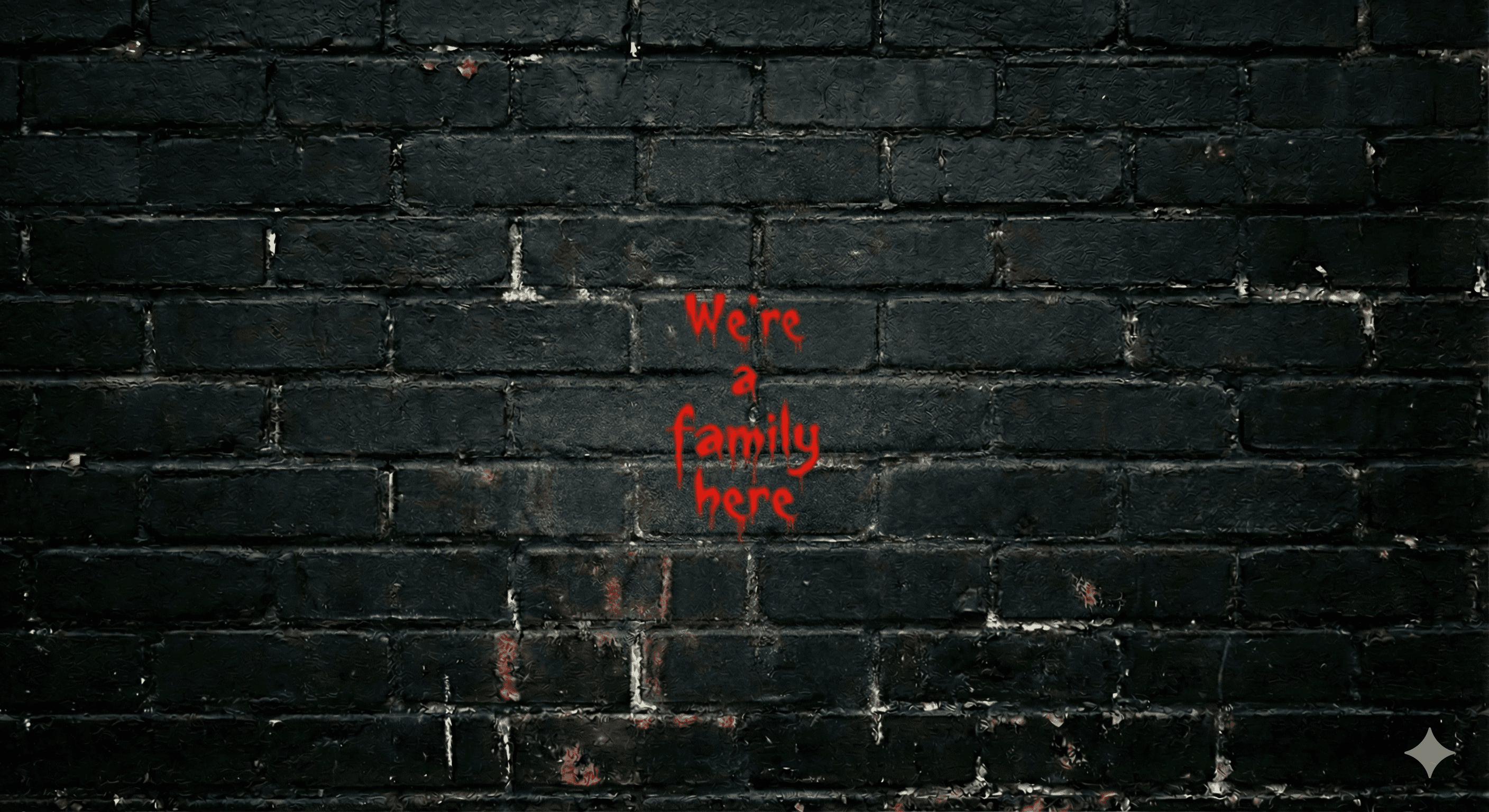
  • We’re a family here

  • We’re all in this together

  • We need to reward loyalty

  • Now is not the time for dissent

On the surface it sounds warm. Underneath, it is a control mechanism.

Amy Edmondson’s research at Harvard on psychological safety shows that teams only learn and improve when people feel safe to challenge, question, and admit problems. Google’s Project Aristotle found the same thing. Psychological safety was the single strongest predictor of high performing teams. Not talent. Not experience. Not seniority. Safety to speak.

When leaders punish dissent, even subtly, they do not eliminate problems. They eliminate visibility of problems.

The “Duchess of Doom” in the song is not just a cartoon villain. She represents a familiar leadership failure pattern.

First, insecurity masked as authority.
Leaders who surround themselves with yes people are not building high performing teams. They are building insulation. Research from McKinsey and others shows that teams with low cognitive diversity make weaker strategic decisions and miss market shifts more often. Agreement feels good. It just does not make you right.

You see it in commercial reviews where the forecast is clearly off but no one challenges it.
In meetings where bad news, or poor updates, are softened with forced enthusiasm so it does not upset the boss.
In everyday calls where people stay quiet for fear of being labelled “not on the bus”.

Second, fear replacing accountability.
When performance drops, healthy leaders look at systems, strategy, and capability. Fear based leaders look for excuses. The economy. The market. The competition. Activity levels. The number of calls being made. The number of webinars delivered. Anything except their own decisions. Blame becomes a shield.

Third, loyalty tests disguised as culture.
Employee surveys, engagement scores, and values statements are meant to surface truth. In toxic cultures they become compliance tests. Say the right thing or be labelled “not a team player”. Edmondson’s work shows that when people believe honesty will be punished, they stop giving it. What remains is performative positivity and quiet disengagement.

Fourth, outdated thinking protected by power.
Leaders who cannot adapt often suppress challenge rather than update their worldview. Instead of learning, they double down. Instead of experimenting, they enforce obedience. The organisation freezes while the market moves, doing more of the same while telling itself it is being “productive”.

The most dangerous phrase in all of this is often said warmly:

“We’re a family.”

Real families argue. They challenge. They tell uncomfortable truths. What these workplaces often mean by “family” is something else entirely. Loyalty without reciprocity. Submission without safety. Gratitude instead of growth.

Gallup’s long running research is blunt. People do not leave companies. They leave managers. More specifically, they leave environments where they feel unheard, unsafe, and undervalued. The cost is not just emotional. It shows up in productivity, innovation, retention, and ultimately, revenue.

The commercial damage follows a familiar pattern:

  • The smartest people leave first

  • The most honest voices go quiet

  • Decisions get slower and worse

  • Strategy becomes theatre rather than reality

Toxic leaders rarely prepare successors, let alone ones who think differently. They promote people who look and sound like them. The behaviour and the blind spots replicate.

From the outside everything can look stable, especially if there is still some growth. From the inside, it is brittle.

There is a clear difference between strong leadership and fear based management.

Fear based leaders want agreement. Strong leaders want truth.
Fear based cultures reward loyalty. Healthy cultures reward contribution.
Fear based teams perform for optics. Healthy teams perform for outcomes.

The song captures the theatre of it. The bravado. The forced cheer. The nervous laughter when the leader asks, “We’re a family, right?”

The real lesson for anyone building or leading a team is simple and uncomfortable.

If you only put people around you who will not challenge you, you are protecting your blind spots.
If you punish bad news, you will only receive good lies.
If loyalty matters more than truth, performance will always be compromised.

Healthy organisations are not built on fear, flattery, or forced positivity. They are built on:

  • Psychological safety, where people can speak without risking their livelihood

  • Constructive conflict, where ideas are challenged but people are respected

  • Accountability, where leaders own results rather than explain them away

  • Adaptability, where being wrong is treated as data, not as treason

The real opposite of the Duchess in the song is not a softer leader. It is a braver one.

Brave enough to be challenged.
Brave enough to hear what is not working.
Brave enough to let smarter people make them uncomfortable.

If everyone around you is nodding, ask yourself whether they agree or whether they are afraid.

Because the moment a leader needs constant obedience to feel safe, the team stops thinking and starts complying. People perform for approval rather than speak the truth. And when that happens, progress slows to a crawl.

It is the job of CEOs and CHROs to spot this and act. Far too often, though, they enable it via inaction or denial instead.

Listen to "Family (or Else)" on Marketing Mixtape

Jan 24, 2026

5 min read

Reply All Apocalypse cd cover on lava

The Most Dangerous Button in Your Inbox

We have all lived through some version of this:

  • A harmless email.

  • A global distribution list.

  • One accidental click.

And then the sound that haunts us all.
The PING that means it is already too late and the replies are on their way.

It is really quite funny to watch it unfold in real time. That is, unless you are the poor unfortunate who clicked send.

I wrote the song “Reply All Apocalypse” after hearing about someone accidentally emailing fifty thousand people about a lasagna left in the office kitchen. It is ridiculous. But it is also a perfect illustration of how one small, human mistake can expose just how fragile our communication systems and habits really are.

We have built incredibly powerful, frictionless tools and then handed them to humans who are distracted, rushed, emotional, and perfectly capable of clicking the wrong thing at the worst possible moment.

Because everything now moves at digital speed and digital scale, small errors no longer stay small.

They cascade.

  • One misplaced message becomes fifty thousand.

  • One well meaning correction becomes a storm.

  • One attempt to fix it makes it worse.

The Reply All Apocalypse is a perfect example of how scale amplifies behaviour.

It is not that people are stupid. It is that the systems we have woven into every part of working life are unforgiving.

Email was designed for one to one or small group communication. We now use it as a broadcast channel, a filing system, a task manager, a knowledge base, and a cultural backchannel. We have loaded it with responsibilities it was never designed to carry, and then we act surprised when it buckles.

There is also something deeply human in the way these storms unfold.

First comes confusion:

  • Why am I seeing this?

  • Who is this?

  • Is this meant for me?

Then irritation:

  • Please remove me.

  • Stop replying all.

Then the hero complex:

  • The person who thinks they will save everyone by telling everyone to stop.
    By replying all.

And finally, resignation:

  • Outlook freezing.

  • Servers groaning.

  • The slow realisation that the only way out is for everyone to stop at once, which of course never happens.

From a leadership and organisational point of view, these moments are small but revealing. They show how easily noise can drown out signal.

The original message, about a lasagna or anything else, becomes irrelevant within seconds. The system is now talking to itself. The thread becomes the story, not the substance.

There is a parallel here with much bigger moments in modern B2B.

  • One badly thought through internal announcement.

  • One campaign email sent before it is ready.

  • One vague change message that sparks a hundred anxious replies.

Suddenly people are no longer discussing the decision. They are discussing the confusion. The reaction loop becomes the event.

Reply All storms are a reminder that communication at scale has dynamics of its own. Momentum. Feedback loops. Unintended consequences.

Good marketing organisations design for that.

The real skill in a Reply All apocalypse is not typing faster. It is knowing when to do nothing.

  • To resist the urge to correct.

  • To resist the urge to be seen fixing it.

  • To resist the urge to add one more voice to the noise.

Sometimes the most professional thing you can do is close the thread and let the system calm itself down. To pause. To not let emotion and ego make a situation worse.

The song ends, as these stories usually do, with the quietest and most human moment.

Someone finally takes responsibility and puts their hand up.
The simple truth emerges from the rubble.

It is absurd. It is familiar. And it is a small, operatic reminder that in a world of instant, infinite distribution, the biggest disruptions are often caused by the tiniest clicks.

Listen to Reply All Apocalypse on Marketing Mixtape

Jan 24, 2026

3 min read

table for ten album cover

Table for Ten and the Truth About Marketing Awards

There is a moment every B2B marketer recognises.

The email arrives.
“Congratulations, you have been shortlisted…”

You have not submitted anything yet.
You have not paid the entry fee.
But somehow, you are already excellent.

I have even worked for organisations that were shortlisted and won awards for services we did not even provide. I blocked them.

The song I wrote, Table for Ten, exaggerates it for effect, but the system it is mocking is very, very real.

Over the last twenty years, the number of business and marketing awards has exploded. Industry bodies, publishers, agencies, consultancies, and “communities” all run them. Categories multiply and get sillier every year. Entry fees rise. Sponsorship packages appear. Tables are sold. Shortlists get longer. Winners become more plentiful.

And the running time of these events now seems close to breaching human rights.

Excellence has become scalable.

The commercial model is not complicated.

  • Charge for entries.

  • Charge for sponsorship.

  • Don’t pay judges.

  • Sell tables.

  • Publish a press release for every winner.

  • Upsell webinars or publications to winners.

  • Encourage social sharing.

  • Offer early bird discounts for next year.

  • Repeat annually.

It has been a long time since awards were mainly about recognition. They are a revenue engine.

They are not designed around truth. They are designed around throughput.

More categories means more finalists.
More finalists means more tables.
More tables means more revenue.

Excellence has become a unit of sale.

None of this means every award is meaningless. There are still programmes with real judging rigour, respected panels, and genuine peer recognition. But the signal to noise ratio has collapsed. We all see it.

Research into award credibility across professional services shows the same structural weaknesses again and again.

First, self reported performance.
Most entries are narratives, not audits. Impact is described, not verified. Judges rarely have access to raw data and almost never have the time to challenge it in depth. I agreed to judge one awards programme for B2B marketers and only did it once. We were constantly rushed to decide without properly interrogating any of the claims.

Second, category inflation.
As events grow, so do the labels. Not because the discipline has become that granular, but because more categories mean more revenue. “Best Use of X in Y for Z Segment in this Very Specific Geography” is not taxonomy. It is inventory creation.

Third, pay to play dynamics.
Entry fees, sponsorship, and table purchases do not explicitly buy trophies, but they do buy probability. Volume of entries, visibility on the night, and commercial proximity all increase the odds of walking away with something shiny.

The song’s line about judges working for free is also worth highlighting. Most panels are unpaid, time poor, and asked to assess hundreds of submissions in compressed windows. Even with the best intentions, scrutiny becomes surface level.

Then comes the theatre.

  • The black tie.

  • The drum roll.

  • The host.

  • The lighting.

  • The word “prestigious” doing heroic work in every sentence.

Awards borrow the visual grammar of credibility. But credibility does not come from staging. It comes from consequence.

Which leads to the uncomfortable question.

Do customers care?

Every serious study of B2B buying behaviour says broadly the same thing. Buyers trust peers, proof, outcomes, and experience. Analyst validation and references matter. Case studies matter. Demonstrable results matter.

Award logos barely register. Procurement might glance at them when comparing suppliers on large tenders, but experienced B2B buyers know the game.

Journalists know this too. Which is why most award press releases die quietly and quickly. They are not news. They are advertisements in narrative form, picked up only by automated newswires.

Internally, however, awards serve a different function.

  • They validate effort and pad out a CV.

  • They give younger team members something to celebrate.

  • They provide an excuse to get glammed up and have a night out.

  • They give leaders some “good news” to share.

  • They offer a morale moment in hard quarters.

There is nothing wrong with recognition. The problem starts when the symbol replaces the substance.

You see it in the Monday morning Slack message.
“Great job team, I’ll add it to the website and pitch deck.”

You see it in agency credentials that lead with trophies before outcomes, which is deeply off putting to competent CMOs.

You see it in board slides where “industry recognition” fills space when pipeline is thin.

When applause becomes easier to earn than results, people start optimising for the applause.

That is why the Table for Ten lyric lands.

In many award circuits, the fastest way to feel like a winner is not to build something genuinely brilliant. It is to pay for a beautifully written entry, buy a table, submit in multiple categories, and increase your statistical odds.

The plastic trophy is not the problem. The confusion of what it represents is.

Awards can be a byproduct of excellence.
They are a terrible substitute for it.

  • Enjoy the night.

  • Celebrate your team.

  • Clap for the winners.

  • Take the photo.

But be honest.

If your proudest slide is the awards slide, you should be worried.

Because the market does not care how many times you have been shortlisted.
It only cares whether what you do actually works.

And if your marketing success depends on trophies rather than customers, you are not building a brand.

You are renting applause.

Listen to Table for Ten on Marketing Mixtape

Jan 24, 2026

4 min read

champagne CMO CD

How to Spot a Champagne CMO in the Wild

There is a particular character many of us have met in our careers.

They arrive with a fanfare. A big title. A big salary. And a reputation that somehow always seems to survive the wreckage they leave behind.

The ink is barely dry on the contract and already they are restless.

They have not met the team.
They do not yet understand the product.
They could not explain the customer problem if you gave them a whiteboard and an hour.

But they know one thing with absolute certainty.

Everything needs to change.

  • New website.

  • New brand.

  • New message.

  • New colours.

  • New fonts.

  • New positioning.

  • New strategy.

Tear it down. Start again. Make it visible. Make it loud. Make it look like momentum.

That is what the song Champagne CMO is about. And I have met so many…!

Not bad people. Not even always untalented. But leaders who mistake vanity for progress and optics for impact. Who reach for the biggest, shiniest levers first because they are the most visible, the most award friendly, and the easiest way to signal importance.

The song pokes fun at a familiar pattern.

The rebrand before the revenue problem is understood.
The AI strategy before the go to market is fixed.
The keynote before the pipeline.
The awards table before the sales forecast.

Every year, a new buzzword. A new bandwagon. A new silver bullet.

  • Big Data.

  • The Cloud.

  • Web3.

  • Blockchain.

  • The Metaverse.

  • Artificial Intelligence.

Not as tools in service of a clear commercial problem, but as costumes to be worn. Language to be paraded. Saying the things they think their bosses and the masses want to hear.

Right now, it is Artificial Intelligence. Crowbarred into every conversation. Setting off red flags with every soundbite.

Do not get me wrong. Real AI is coming and it will continue to get better and better. But the Champagne CMOs claiming they have increased productivity by 35 percent or that every new product they launch is now AI led are not people you should be listening to, let alone hiring.

If you put a computer in front of them and said show me, they would not know where to start. But that does not stop them climbing on stages and pretending they are leading the way.

Underneath the veneer is a simple truth. Real B2B marketing is hard. And leadership is harder still.

  • It means doing your best with messy data.

  • It means listening to customers.

  • It means aligning with sales.

  • It means being accountable when the numbers do not move. Yet.

That work is slow. Unsexy. And rarely comes with a trophy or a pedestal.

So instead, some leaders reach for theatre.

  • They polish the brand while the engine misfires.

  • They talk transformation while sales squirm.

  • They chase awards while the team quietly burns out.

And when the cracks start to show, they do what they have always done.

  • Move on.

  • New role. New title. New narrative.

  • Eighteen months later, a golden goodbye and a fresh stage to perform on.

Champagne CMO is not really about one person. It is about a system that rewards confidence over competence, presentation over substance, and short term optics over long term value creation.

It is about how easy it is to look like a leader and how hard it is to actually be one.

The irony is that the best CMOs I have ever worked with look nothing like this:

  • They do not arrive with a rebrand. They arrive with a desire for context.

  • They do not lead with slogans. They lead with listening.

  • They do not chase every new trend. They make sure the boring foundations are in place.

They do not need champagne moments to feel important. They care far more about whether the business is healthier, the team is stronger, and the customer is better served than it was a year ago.

That is the quiet punchline of the song.

Real leadership does not need performance, a parade of buzzwords, or the most expensive bottle in the room.

It just needs to do the work.

How many Champagne CMOs could you name over a drink?

Listen to Champagne CMO on Marketing Mixtape

Jan 24, 2026

3 min read

man on his knees begging for money froma. cfo

What “Six Months to an Exit” Really Means for Your Marketing Team

Every marketer knows the phrase.

Do more with less.

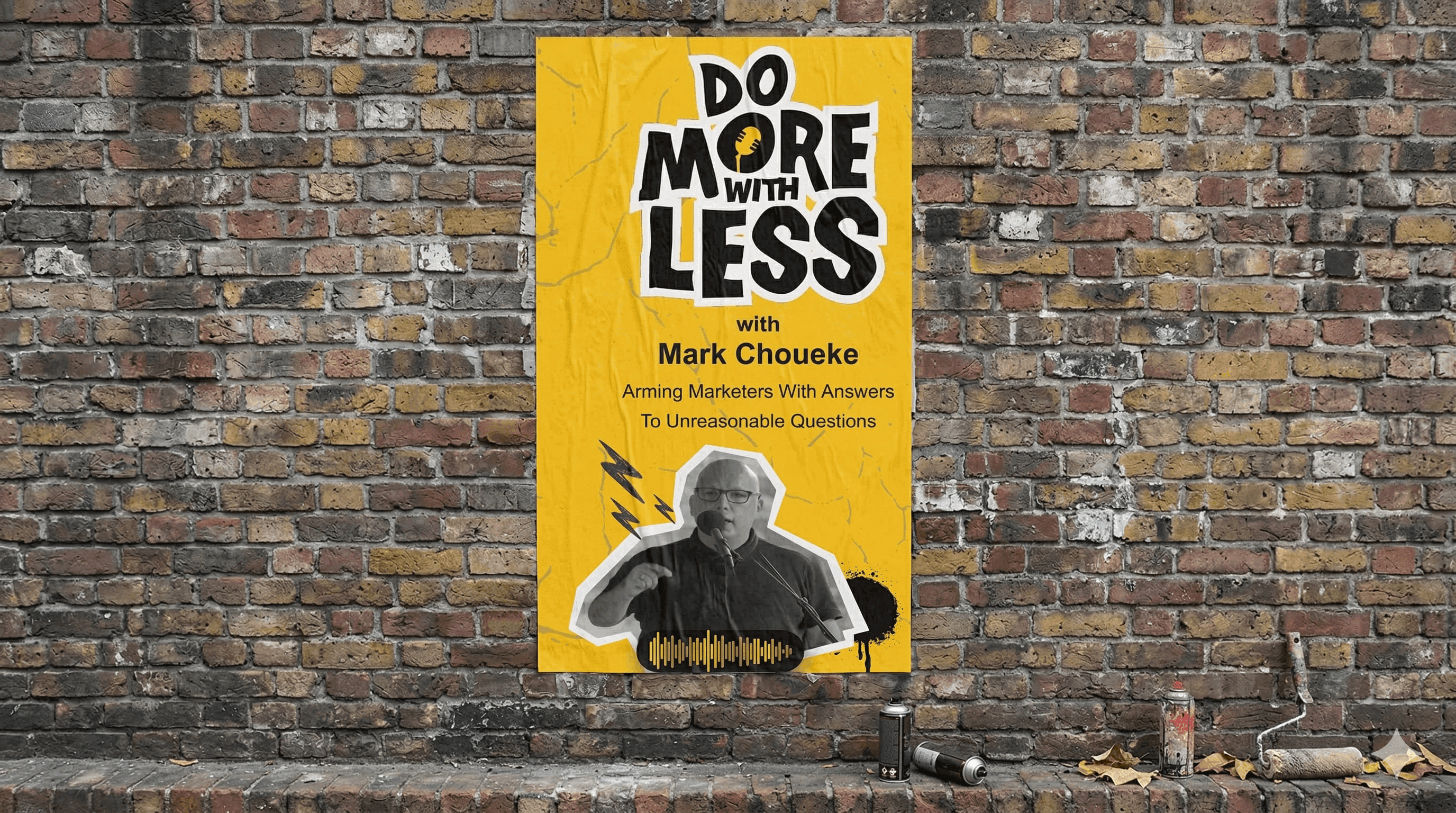
Especially if you follow the B2B marketing legend that is Mark Choueke, who has spent years unpacking what it really means, the damage it quietly does and how marketers can navigate it.

It gets framed as a motivational challenge. A test of creativity. A badge of honour.

In many Private Equity owned businesses, it is something else entirely.

It is a contradiction.

The song I wrote, “Six Months to an Exit”, dramatises a familiar scene. A CMO with a growth plan, a launch vision, a category story to build. And a board that listens, nods, studies the spreadsheet, and then says:

Can you just do the same as last year again.

But faster.

And cheaper.

And with a hockey stick on the end.

This tension is not personal. It is structural.

Private Equity firms are not buying companies to run them forever. They are buying them to sell them. Usually in three to five years. Often sooner. Their job is to improve valuation, and the cleanest lever for that is EBITDA to drive the exit multiple.

Revenue growth matters. But margin matters more.

Predictability matters more than experimentation.

Certainty beats ambition.

None of this is irrational. It is simply misaligned with how marketing actually works.

Marketing is an investment function, not a cost function. Brand, demand, trust, and reputation compound over time. They do not obey quarterly cycles. Yet PE time horizons are often shorter than the payback period of the very activities that create sustainable growth.

Hence the paradox.

  • We want a growth story for the exit deck.

  • But we do not want to fund the growth story.

  • We want a hockey stick.

  • But we want flat spend.

And when this logic meets reality, the internal battles begin.

  • Global marketing needs scale, consistency, and long term bets.

  • Regional leaders own P and L and are measured on this quarter’s number.

  • So they protect local budgets, resist central programmes, and block spend that does not show immediate regional ROI.

Everyone is acting rationally.
Collectively, the system becomes irrational.

Research on matrix organisations and PE backed structures shows that when incentives are misaligned, collaboration drops and political behaviour rises. Marketing stops being a growth engine and becomes a cost to defend or cut.

Then Q4 arrives.

  • The number is missed.

  • The CFO claws back budget.

  • The pipeline still needs filling.

  • Leads are still demanded.

  • But the fuel is removed.

The Head of Sales is probably polishing the CV, because they are often the first fall guy.

This is the purest form of the do more with less fantasy.

  • Can you protect the brand while cutting the voice.

  • Can you grow demand while freezing headcount.

  • Can you hit targets while stripping out the very activities that create them.

Short term, you can make it look like it works.

  • You can window dress.

  • You can push promotions.

  • You can burn the database.

  • You can overwork the team.

  • You can borrow from future quarters to save this one.

For a while, the numbers hold, helped by momentum from past investment. The story stays intact. The exit deck looks clean.

This is why the song talks about smoke and mirrors. It is not incompetence. It is incentives.

  • The buyer wants a smooth story.

  • The seller wants a clean multiple.

  • Management wants to survive the process.

Marketing, which lives in the long game, gets squeezed in the middle.

The tragedy is that the things that create real enterprise value are the first to be questioned.

  • Brand investment.

  • Category creation.

  • New product launches.

  • Modern infrastructure.

  • Senior talent.

They all make the P and L look worse before they make it better. Which makes them politically vulnerable in an environment obsessed with short term optics.

So what does “do more with less” usually mean in these contexts.

  • Not smarter.

  • Just harder.

  • Same expectations.

  • Fewer people.

  • Less budget.

  • More pressure.

And a growing gap between what the business says it wants and what it is willing to fund.

For CMOs operating in PE backed businesses, the job is not just marketing. It is translation.

  • Translating long term value into short term language.

  • Translating investment into risk mitigation.

  • Translating brand into future multiple.

And when you are asked to deliver a hockey stick on a flat budget, the only honest response is not blind compliance. It is clarity.

  • Here is what we can grow.

  • Here is what will stall.

  • Here is what we will be trading off.

  • Here is the risk we are taking, even if we would rather not say it out loud.

Because growth without investment is not strategy.

It is hope.

And hope does not show up in EBITDA.

Listen to Six Months to an Exit on Marketing Mixtape

Jan 24, 2026

4 min read

we're a family here spray painted on a black brick wall

How to build high performance marketing in a toxic “work family” culture

I have long believed that if we could run a root cause analysis on every failed campaign or stalled rebrand, we would find that most failures are not caused by a lack of creative talent or budget, but by a lack of openness.

Some still behave as if high performance is built on “good vibes,” late night pizza, and forced loyalty. But anyone who has ever run a demand engine under pressure knows the real culture is revealed in different moments. In the silence after a budget cut. In the pause before telling the CEO their copy edits make no sense. In the quiet calculation when a marketer thinks, “If I push back on this, will it cost me politically or personally?”

Amy Edmondson’s research at Harvard shows that the highest performing teams are defined by psychological safety. In marketing, this is not a “nice to have.” It is a commercial necessity. You cannot innovate, challenge assumptions, or kill bad ideas early if people are afraid. And bad ideas that survive early always become expensive later.

Creative teams are rarely asking, “Do we like each other?”. They are asking, “Is it safe to have a bad idea here in order to find a good one?”

When loyalty is valued over candor, marketing does not become stronger. It becomes polite, beige, and commercially fragile.

The fallacy of the “we’re a family” culture.

Toxic leaders often describe their teams as “family.” It sounds warm. It sounds caring. In practice, it often becomes a verbal shield used to demand obedience while offering conditional safety.

In B2B marketing, the “we are a family” label quietly teaches people that:

  • Critiquing the leader’s idea is disloyal

  • Working weekends proves commitment, not burnout

  • Questioning strategy means you are “not a team player”

  • Asking for budget means you are “not scrappy enough”

It confuses belonging with agreement.

I once coached a highly capable Head of Demand Gen who admitted that she had stayed silent during a roadmap review for a product launch she knew had no product market fit. Later she said, “The CCO keeps saying we’re a family on a mission and that this was her baby. If I raised objections, I knew I would be isolated.”

The launch produced zero qualified pipeline. The warning was never voiced. The cost was real. The silence was cultural.

Safety versus comfort

Most toxic marketing cultures optimize for comfort. High performance cultures optimize for safety.

Comfort is the absence of conflict.
Safety is the presence of truth.

Comfort keeps meetings smooth.
Safety prevents wasted spend.

In those environments, marketers do not need more after work drinks or fancy dress days. They need to know that insight matters more than hierarchy and evidence matters more than ego.

This is why the best marketing leaders do not demand alignment. They demand thinking.

Cognitive diversity and the “vanilla trap”

Research from McKinsey shows that diverse teams make better decisions. In marketing, lack of cognitive diversity creates what I call the Vanilla Trap. Activity that voice no opinion, takes no risks and influences no-one.

Fear drives this. When people feel unsafe, they mimic competitors, defer to the HiPPO (Highest Paid Person's Opinon), and copy whatever feels politically safe. That is how entire categories end up sounding identical.

High performance teams build mechanisms that force constructive dissent

  • Pre mortems where the team writes the future failure story before launch

  • Red teams whose job is to challenge the value proposition

  • “Kill your darlings” rituals that reward abandoning weak ideas

  • Customer voice as the final arbiter, not senior opinion

Reality check

If your values slide says “innovation” but you punish the social media manager for a post that missed while ignoring the VP who has not refreshed strategy in five years, you are not building culture. You are building learned silence.

Map safety to real marketing roles

Different marketers carry different personal risks:

  • The content lead fears being publicly torn apart for tone

  • The demand leader fears being blamed for missed revenue they do not control

  • The brand lead fears being seen as obstructive

  • The events lead fears one operational miss becoming a character judgement

Safety means making it clear that the cost of silence is higher than the cost of speaking.

Proxies for safety

When you are not in the room, your systems speak:

  • Creative reviews that critique the work, not the person

  • Dashboards that show red numbers without witch hunts

  • Leaders who say “I was wrong” publicly

  • Briefs that are firm on outcomes but flexible on how to get there

These are leadership signals, not process details.

The psychology underneath

Several behavioral forces quietly distort marketing decisions

  • The HiPPO effect where senior opinion overrides evidence

  • Sunk cost fallacy where bad ideas live on because money was already spent

  • Groupthink where tired teams convince themselves mediocrity is excellence

High performance leadership designs systems that counter these biases, not reinforce them with “family” language.

How to deliberately build safety

Practical actions that work:

  • Replace “family” with “high performance team”

  • Separate brainstorming from decision meetings

  • Reward the person who brings the uncomfortable data

  • Protect your team from political bullying from Sales or Product

  • Define failure as learning and then actually behave that way

This is leadership work. And it is commercial work. Unsafe teams waste budget quietly and repeatedly.

How to tell if you are building a team, not a cult

You will see signals:

  • “This isn’t working” is said as often as “This is great”

  • Junior marketers challenge senior leaders

  • Failed tests are shared openly

  • Sales and Marketing debate without posturing

  • You hire for culture add, not culture clone

The simple rule to remember

In complex B2B markets, advantage rarely comes from harmony.
It comes from honesty.

The teams that win are not the politest.
They are the ones that surface the truth earliest and act on it fastest.

Call to action

In your next campaign review, ask one question and then stay quiet.

“If you knew you would not get in trouble, what would you change about this plan right now?”

Listen without defending.
Do not explain.
Do not justify.

Map where silence lives. Decide whether you want to be comfortable or effective.

If you want help building a marketing culture that produces truth, not compliance, and performance, not politeness, contact me and the team at B2B Marketing United and we will introduce you to people who genuinely know what good looks like.


Jan 25, 2026

5 min read

Why Calling Anything Dead Is a Red Flag in B2B Marketing

Sometimes it feels like those in the b2b marketing sector have been in a hurry to write obituaries.

  • Cold calling is dead.

  • Direct mail is dead.

  • TV is dead.

  • Events are dead.

  • Physical is dead.

  • Human interruption is dead.

Digital only. Algorithm first. Everything else is noise.

I have even heard opening keynotes at conferences say it. Much to the chagrin of a couple of outbound calling agencies I know.

It was exactly this funeral march for “old” marketing that pushed me to write a song about it, 'Dead Men Dialling'. Because every time someone declares something dead in this industry, it usually means they have stopped looking closely enough to notice it still working.

It is a cheap and myopic thing for anyone in our profession to claim. The logic behind declaring everything that is not fashionable obsolete is flawed. We confused what is modern with what actually works. And we forgot a basic truth about how markets behave.

When something becomes easy, abundant, and cheap to produce, it loses impact. When something becomes rarer and requires real effort, it starts to stand out.

Marketing is not a software problem, it is an attention problem. And people notice what feels different, not what is easiest to generate.

Look at the environment we have created.

  • Inbox zero is a fantasy.

  • LinkedIn is an echo chamber of recycled thinking and recycled language.

  • Programmatic ads chase each other down the page.

  • AI has turned “good enough” into a factory setting.

Scale is no longer the edge. Being indistinguishable is the risk.

And in a market full of identical digital output, anything that feels physical, human, or effortful suddenly cuts through. And that’s what all b2b marketers should be aiming for. To cut through.

That is why the so-called dead tactics are not dead at all. They are being used by the people who refuse to run their entire go to market through the same pipes as everyone else.

  • A physical letter on a desk now gets more attention than another unread email.

  • A real phone call lands differently in a world of automation.

  • A proper conversation at an event carries more weight than another video meeting.

  • A TV ad that builds memory does more than a million forgettable impressions.

Not because these things are nostalgic. Because they are now unusual.

I’ve seen proof of this in real life:

  • A Sales Development Rep who finally got a meeting because they sent something physical to get the attention of a prospect that had long ignored their other outreach attempts.

  • A CMO who admitted their best lead of the quarter came from a chance conversation at a trade show.

  • A founder who said the deal that mattered most started with a phone call and then dinner, not an email campaign.  

For years we were told that efficiency was everything. That friction was the enemy. That faster and cheaper automatically meant better.

But meaning does not come from speed, credibility does not come from automation and trust does not come from convenience.

Digital did not kill the old channels. But digital has made itself ordinary.

  • Performance marketing has become a tax, not an advantage. It often feels like selling pounds for pennies.

  • Reach is everywhere. Distinctiveness is not.

  • Click through rates barely move the needle.

  • Algorithms change. Costs rise. Margins get squeezed.

Meanwhile, brand, memory, physical presence, and human contact are quietly becoming the real sources of advantage again.

Not because they are new but because they are harder to implement without effort.

  • Hard to automate.

  • Hard to scale without care.

  • Hard to do badly without being noticed.

What is really happening is simple.

Everything is now fast, cheap, and easy to ignore. So the things that stand out are the ones that feel like someone actually bothered.

A real voice on the phone feels different because most contact is templated. A physical object feels different because everything else lives on a screen. Being in the same room feels different because so much interaction has become weightless.

Not because these things are romantic or retro. Because they require effort. And effort is still the clearest signal of intent we have.

The mistake was thinking progress meant replacement.

It does not. It means rebalancing. Markets are human systems, not just data systems. And humans do not respond to abundance. They respond to contrast.

So the so-called dead tactics are not coming back because they were misunderstood.

They are resurfacing because the environment has changed.

They called it a graveyard. What it really was, was a misdiagnosis.

The old guard did not die.

They were waiting for the moment when being human became the competitive advantage again.


Jan 24, 2026

4 min read

woman holding a large jigsaw piece

Prove It Fast: The Fractional CMO Reality

They arrive mid-stream, often mid-problem, sometimes mid-crisis. The brief is rarely clean. The data is rarely complete. And the expectations, while often unspoken, are immediate. In fractional leadership, time is compressed and credibility is perishable.

This is the reality of modern fractional marketing, and it is reshaping what senior marketing leadership looks like.

Unlike their full-time counterparts, fractional CMOs don’t inherit the benefit of long-term belief. They are not afforded quarters to “get their feet under the desk” or months to build internal alliances. Instead, they are expected to demonstrate clarity, confidence and commercial impact almost on arrival. The implicit question hovering over every early meeting is simple: did we make the right call?

What clients are really buying when they engage a fractional CMO is not execution, nor even strategy in the traditional sense. They are buying certainty. They want someone who can look at a complex, often dysfunctional marketing engine and say, with conviction, what actually matters and what does not. Speed, in this context, is not about activity. It is about judgement.

This is where many fractional engagements falter. The temptation to prove value through motion is strong. Campaigns are launched. Frameworks are presented. Decks grow longer. But activity without direction rarely builds trust. In fact, it often does the opposite. Experienced leadership teams recognise noise when they see it.

What builds confidence early is pattern recognition. The ability to spot familiar failure modes quickly and articulate them clearly. Whether it is misaligned positioning, a bloated channel mix, or a conversion problem masquerading as a demand issue, the best fractional CMOs name the real problem before they attempt to solve it. That moment of recognition, when stakeholders feel seen and understood, is often the true starting point of influence.

Reframing is a particularly powerful tool in the fractional arsenal. When a new leader can restate a company’s challenge more accurately than it has been able to itself, credibility accelerates. It signals not just intelligence, but experience. It says: I’ve seen this before, and I know where it leads if left unchecked.

Early impact, however, is not about fixing everything. Fractional CMOs succeed when they create visible momentum in one meaningful area. A single commercial win, a clarified decision, a simplified process. Something tangible enough to be felt in the business, not just discussed in meetings. One clear improvement buys time, trust and space to tackle deeper structural issues.

Decision velocity is another underappreciated marker of fractional success. Organisations often engage fractional CMOs because they are stuck. Too many opinions, too much legacy thinking, too little conviction. When decisions start being made faster and with more confidence after a fractional leader arrives, value is being proven, even if the numbers have not yet fully caught up.

Communication plays an equally critical role. Fractional CMOs are constantly performing a balancing act: calm without complacency, urgency without panic. Overpromising erodes trust. Overexplaining does the same. What leadership teams respond to is clarity; what matters now, what can wait, and what simply should not be done at all.

Ultimately, the real measure of a successful fractional engagement emerges quietly. It is not found in dashboards or reports, but in absence. When leaders begin to wonder what would break if the fractional CMO were no longer there, the role has shifted from optional to essential.

Fractional marketing leadership is not about being helpful. It is about being decisive, credible and commercially sharp, quickly. It demands strong points of view, comfort with ambiguity and the confidence to lead without formal authority. Those who thrive in this model understand that proving it fast does not mean doing more. 

It means seeing more clearly, sooner.

Jan 1, 2026

3 min read

CMO sitting at desk assessing briefs

How to avoid common mistakes when writing a marketing brief?

Over the last few decades in numerous CMO roles, I have written, received, rewritten and quietly apologised for more marketing briefs than I care to remember. I have also been on the other side of the fence, receiving briefs so poor they make me wonder if the sender should be issuing a brief to help them write a brief.

A good brief is about clarity. It exists to remove ambiguity, so the people you want to pay to solve your problems are on the same page as you and set up to succeed, in a way that you and your team actually benefit from.

In b2b marketing, most briefs start with a decision that has already been made. A campaign is needed to launch a new product. The team has decided it is finally time for marketing automation. It is time to refresh the brand identity. Somebody wants to jump on the account based marketing train. Completely normal.

The brief is not there to pretend you are starting from scratch. It is there to explain the thinking behind the decision, what you need and why, what resources you have to play with, and how you will know an agency is the right one for you. If a brief is too bad, the perfect agency might even decline to pitch in the first place, so shooting yourself in the foot.

Most bad marketing briefs are not written by bad marketers. They are written by busy people trying to move things along.

The problem is that small mistakes at the briefing stage snowball. What starts as vagueness turns into guesswork. Guesswork turns into key people being on different pages. This could lead to shoddy work. And that turns into frustration on all sides.

Like all things, everyone has their own opinion. But here are the most common mistakes I see in b2b marketing briefs.

Mistake 1. Treating the brief like admin

This is the big one. When a brief is treated as something you have to get done, rather than something that helps you think, it shows. The language is vague. The logic is loose. Key decisions are missing.

Sometimes I get the impression people think the brief is just admin that will be put right in the face to face briefing. It is not. The brief is the one truth. It is the moment you decide what you actually want and explain it clearly enough for someone else to help. If you rush it, you will pay for that later in time, money and goodwill.

Mistake 2. Pretending some decisions have not been made

Many briefs dance around reality. The business already wants a campaign. Or a new brand identity. Or outside help. Or a new direction. But the brief is written as if everything is still up for debate.

This creates confusion immediately. Agencies do not know whether they are being asked to diagnose a problem or execute a solution. Be honest. If a decision has been made, state it clearly. You have 100% decided to use Sitecore over WordPress? Say so.

Clarity is not limiting. It is invaluable.

Mistake 3. Being vague about the problem

Briefs often describe what needs to be done without explaining why. We need more awareness. We need better leads. We need to stand out. None of this helps.

What is actually not working as it should. Where are things breaking down. What prompted this brief now. Without that context, people are forced to guess at the real problem and the work will drift.

Why not help agencies by giving them valuable context upfront. Do not rely on them asking the right questions. Give them the lowdown. Give them the inside track. Proactively.

Mistake 4. Asking the work to do too many things

If your brief has ten objectives, it has none. One brief should have one main job. You can include secondary goals, but you need to be clear about what matters most and what trumps everything else if time or resources get tight.

When everything is a priority, nothing is. This is how work ends up watered down and compromised. Focus is not a nice to have. It is what makes work effective.

Mistake 5. Defining success with buzzwords

Success is often described in language that sounds impressive but means very little. And as b2b marketing people, we can be the worst offenders. Best in class. Cutting edge. Market leading. These phrases do not give anyone something to aim for.

Describe success in plain English. What needs to happen for you to know this project has been successful. What about from your stakeholders’ perspective.

Ideally the metrics are quantifiable. At a minimum, they should be SMART: specific, measurable, achievable, relevant and time bound. If you cannot explain success clearly, you will struggle to recognise it when it happens, praise those who delivered it, or hold people and agencies accountable if it did not.

Mistake 6. Rubbish personas

Everyone is not a target audience. And neither is a rubbish persona.

I am generally alarmed at how bad b2b marketing people are at personas. I have seen personas cross my desk with entirely useless traits, like they have three kids, like skiing, reading books and eating Mars bars. That is a real example. It serves no purpose. It fools nobody. More importantly, it adds nothing to the brief or the outcome.

An agency will never know your customers as well as you do. Good personas help them make better decisions on your behalf. Focus on what matters. What job titles buy your services. What pressures are they under. What does success look like for them. What do they fear. What do they need to believe to choose you. What tools and processes do they live in. That is the sort of thing I want to see, not where they go on holiday.

Mistake 7. Listing features instead of benefits

Much like personas, b2b marketers people also struggle with value propositions.

Listing features, locations, or how many employees you have is not a value proposition. The best briefs articulate why prospective clients would be interested in your service and why. How will you help them be more successful. What challenges do you solve and how. What does that mean for them as a business and as an individual. Why should they choose you rather than a competitor.

Mistake 8. Hiding constraints until later

Budget, timelines, legal requirements, internal politics, technical limits. These things exist whether you write them down or not. Leaving them out of the brief does not make the work more creative. It just pushes the problem down the road.

Hiding the budget is often framed as being savvy. It rarely is. It just forces people to guess, then compromise decent ideas later when the budget inevitably comes out. That helps no one.

If you cannot share an exact budget, give a range. If you cannot talk about the politics, at least describe the internal perception you will need to overcome. If legal is normally extremely risk averse, flag it early. Give agencies a chance of charting a course through the maze.

Agencies can work within constraints. What they cannot do is plan around information they do not have. Put the reality on the table early. And yes, there are always ways to say the sensitive stuff without spelling it out. Come on. You are marketers. Be creative.

Mistake 9. Being unclear about what is fixed and what is flexible

Many briefs leave agencies guessing about where they can challenge you and where they cannot. Is the message locked. Is the channel fixed. Is the timeline immovable.

If everything feels fixed, you will get safe work. If nothing feels fixed, you will get confusion. A good brief separates non negotiables from areas where thinking is welcome.

Mistake 10. Forgetting to say how you will choose

If this is a pitch, one of the biggest mistakes is not explaining how decisions will be made. What matters most. Thinking or polish. Experience or fresh perspective. Chemistry or credentials. Who is involved.

When you do not say this, agencies pitch to whatever they think you secretly want. That rarely ends well. Being clear about how you will choose is basic fairness and improves the quality of responses dramatically.

Mistake 11. Not giving all agencies the same information

I have been a stakeholder in pitches where some agencies were given more information than others. I always call it out. It is not fair and it skews the outcome.

I once had a head of procurement ask me to answer a question from one agency during an RFP process. I was happy to do it, but only if the question and answer were shared with all bidding agencies. They pushed back and said the other agencies should ask better questions if they wanted the extra context.

I reject that thinking. The agency asking good questions is great but my team want the best outcome and we do not have time to play games. Share the information and get to a better result faster.

Mistake 12. Sending the brief and hoping for the best

A brief is not finished when you send the document. Writing it and briefing it are not the same thing. If you do not talk it through, answer questions and confirm shared understanding, you are leaving too much to chance.

Send the brief. Talk them through it. Be prepared to refine it. If you just email a brief, it is a waste of time. You will not get anyone’s best people or best thinking aligned to the brief. And from an agency point of view, I would not want to bid on anything for someone I have not had a conversation with. The best agencies will push back on this. That is one of the ways you spot them.

Mistake 13. Not considering compensating bidders for their time

This may be controversial and not every budget allows it, but I have compensated losing bidders for their time, even if it is a small but meaningful gesture.

Agencies spend real time and expertise responding to your brief. Creative agencies incur real costs. If your budget allows, recognise that. Even if you went in a different direction, you valued their thinking and it helped you get to the right decision. A simple gesture can leave the door open to work together in future, and it is the decent thing to do.

The simple rule that avoids most mistakes

If there is one rule I stick to, it is this. A good marketing brief should make it obvious what is being bought, why it exists, who it is for, what success looks like and how the work will be judged. If any of those are unclear, the brief is not ready yet.

Most briefing mistakes come from rushing, avoiding decisions, and treating the whole thing like an administrative task. Slow down. Decide properly. Write it clearly. It is one of the highest ROI things you can do in b2b marketing.


Dec 30, 2025

9 min read

Previous
Next
Picture of Nigel

A CEO’s Guide to What Really Matters in B2B Marketing

As a CEO, many CMOs are effectively chasing your attention. When they invest heavily in ultimate guides and thought leadership content, what do they need to do differently to get you to engage?

It’s got to be relevant and it’s got to be accessible. I do download content fairly often, but I don’t tend to download massive documents - I just don’t have the time. Time is critical.

I prefer what I’d describe as snackable content. I think a lot of people are overwhelmed by the volume of information out there and we’re all short on time. Most PDFs end up in my “to read” folder and then never actually get read.

The issue isn’t necessarily the insight, it’s the format it’s delivered in. I prefer fast, accessible content: videos, podcasts, short pieces that I can consume easily.

There are exceptions. There are a couple of documents I read every year because they’re directly relevant to the business challenges I’m facing. But fundamentally there’s just a lot out there, so content needs to be targeted, relevant, and consumable.

Many B2B marketing teams would say they already tick those boxes. Is that enough?

There is a lot of repetitive content out there. You only have to look at how many articles are being published on AI, they’re often saying the same things and delivered in the same way.

If content tackled issues in a slightly different way, or was delivered in a more engaging or distinctive format, that would definitely get my attention. Right now, a lot of it looks and sounds the same.

Is content consumption always “on” for you, or are there moments when you actively seek things out?

Personally, I like reading and taking on content. If I’m dealing with a specific business challenge, I’ll actively go out and find solutions to that problem. I’ll ignore a lot of content that feels generic or irrelevant, but when I need to dig into something, I’ll seek it out.

You’ve held senior GTM roles across major organisations. When you look at a marketing dashboard, what’s the metric you care most about and which ones do you have no time for?

The metric I care about most is marketing-sourced pipeline, but it needs to be real pipeline. Opportunities that are actionable and can turn into revenue.

Marketing-attributed revenue is another key one. A single number that shows whether marketing is genuinely helping grow the business.

Those metrics aren’t always available straight away because they rely on good data, systems, and workflows. That data might come from the website, events, inbound enquiries — wherever. But that’s what I want to see.

Vanity metrics, on the other hand, things that look good on dashboards but don’t translate into revenue,  are less helpful. Page impressions, generic page views, follower counts: they matter, but they don’t tell me whether we’re generating qualified demand or revenue.

You’re also a practicing artist. Has creativity influenced your approach to marketing?

I’ve been painting pretty much all my life. I wanted to go to art college originally, but my dad encouraged me to get what he called a “proper degree”.

A few years ago I had some downtime and got back into my artwork. We have a place in Cornwall, and I started creating sea-life-inspired pieces in a pop-art style. A gallery there picked them up and began exhibiting them.

So yes, creativity has always been part of who I am.

How does that creative side show up in your marketing philosophy, particularly around brand versus performance?

Brand awareness is vitally important. It doesn’t always translate immediately into revenue metrics, but being known for something,  what you’re good at, what you stand for,  really matters.

That said, particularly in tougher times, you have to stay focused on growth and revenue. Some marketing metrics simply don’t add value when you’re trying to understand how the business is actually performing.

So it’s about balance. Brand supports long-term growth, but it has to sit alongside clear commercial outcomes.

If a downturn hits and budgets need to be cut quickly, where do you start?

I wouldn’t start by cutting marketing. It’s counterintuitive. You can’t cut your way out of trouble, you have to grow your way out.

Marketing is a lever for growth, not a discretionary cost. I’d look elsewhere first: vendor consolidation, travel, back-office duplication, non-core projects.

In one organisation I worked in, we had around 800 internal projects running at once, many solving the same problems in different ways across regions. We shut most of them down and replaced them with a smaller number of consistent initiatives. The cost savings were significant.

If marketing cuts are unavoidable, it should be about reallocation, not elimination. Dial back experimental activity, but protect channels that reliably generate demand; account-based marketing, targeted industry events, proven performance channels.

You’ve written about the productivity paradox. Are marketers over-tooled?

Yes, I think there are too many tools in most organisations, and that adds complexity. Individually the tools are fine, but collectively - especially in global organisations - they create friction, and friction reduces productivity.

I’ve worked in businesses operating across 30 countries, each with its own CRM system, analytics tools, and implementations. That fragmentation adds cost and slows everything down.

There are huge savings and productivity gains to be made through consolidation. There are dozens of platforms- HubSpot, Salesforce, Marketo, Pardot, Mailchimp, Hootsuite and many more - all doing similar things.

Reducing the number of tools and standardising how they’re used is absolutely key.


Watch the full interview on the B2B Marketing United YouTube channel.

Image of john Coe

The Godfather of B2B Marketing on Sales, Trust and Why Fundamentals Still Win

Often described as the Godfather and one of the true forefathers of B2B marketing, it’s an honour to speak with you today. You’ve famously talked about speaking from “both sides of your mouth” - can you explain what that means for B2B marketers, and why having both perspectives really matters?

Well, I started my career in sales and spent quite a bit of time in sales and sales management. Then, according to my friends in sales, I went to the dark side and moved into marketing, primarily because of lead generation. That’s a long story.

But the fact of the matter is, I think any marketer in B2B needs to either have been in sales or really understand sales. The old phrase “walk a mile in my shoes” really applies here - it equips marketers to do a better job.

For B2B marketers who haven’t had the opportunity to work in sales - do you have any advice on how marketers can at least empathise with and understand that world?

That’s a good question. When I get a new client, one of the first things I ask is whether I can travel with their salespeople for a day or two - and not just one salesperson. I like to spend time with two or three.

What I find is that within the first half-day, they’re suspicious of me. But once they realise I understand sales, they open up. And when they do, the gems that come out of their mouths are incredible and hugely valuable for future marketing efforts.

You’ve got to get that trust right, and that empathy means they see you as a friend, not a foe.

And John, taking that thought further, your book The Fundamentals of B2B Sales and Marketing - there’s a clue in the title. You’ve developed a new sales coverage model. Is that a useful framework for marketers looking to build empathy and understanding with sales?

First, I should say not all situations are the same. Selling office furniture is very different from selling a machine tool that has to be designed. You need to define what you’re selling before you can design a coverage model that makes sense.

Do you use distributors or not? Does your coverage model rely on face-to-face interaction as a primary channel? Coverage models vary based on what you’re selling and who you’re selling to.

For example, in manufacturing, you’re often selling to engineers, not purchasing agents. These two factors drive very different coverage models.

That’s a great point. We talk a lot today about group marketing, where marketers need to engage multiple roles within large organisations, each with different interests in the product or service, and adapt messaging accordingly.

That’s what’s now called account-based marketing, and I completely agree with it. Even when I was in sales years ago, I did things people didn’t expect. I’d talk to purchasing, but I’d also go to the plant and speak with production scheduling. As a result, we often exceeded what the contract originally allowed.

If you’re selling to enterprise accounts, there can be five, ten, or more people involved in the decision. Marketers need to understand who they’re communicating with and that communication isn’t one-size-fits-all.

Exactly. And John, am I right in thinking that there was a version of ABM in 1980 -  it just wasn’t called ABM back then.

Yes, back then it was called Strategic Account Management.

Today, B2B marketing is one of the fastest-growing industries in the developed world. What did you see all those years ago that made you register b2bmarketing.com? What told you this was coming?

It wasn’t so much what I saw, it was what I experienced. At the time, people were underestimating the size of the B2B market. 

Think about a car. You buy one consumer product, but behind that car are 100 to 200 B2B suppliers. People focused on the consumer product and ignored the massive B2B ecosystem behind it.

I saw that because I came from sales. When I moved into marketing, many people had never worked in sales and underestimated both the size and potential of the market. Eventually, that changed and that’s why B2B has grown the way it has.

What has surprised you most about the rapid growth of B2B marketing?

One major surprise over the last five to ten years has been the explosion of technology. I’m an old face-to-face guy, and now there are nearly 14,000 software packages in sales and marketing.

The issue is that people adopt technology and forget the fundamentals. They hope technology will fix their problems, generate leads, build relationships, but without fundamentals, that’s a mistake.

Young marketers love tech. Older ones like me worry about fundamentals being lost.

That balance is fascinating. Technology has brought choice, but also choice paralysis. With AI now dominating the conversation, have the fundamentals of B2B marketing actually changed?

One thing that hasn’t changed is the emotional side of B2B buying. I’m writing a report on this now. We make emotional decisions first,  trust,  before we justify them with facts.

B2B marketing has historically ignored this emotional element, even though purchase decisions often involve significant personal and career risk.

Exactly. Buying a cheap personal item is one thing. Buying something expensive at work means spending someone else’s money,  and that’s emotional.

Take a CRM system. Choosing or changing one can be career-ending if it goes wrong. Yet most marketing ignores that risk and emotional trust requirement.

And we’re back to buying groups again - different roles, different concerns, same product.

Correct. Purchasing, finance, users, sales managers - each has different needs and trust factors. Messaging must be relevant to each.

Do you remember the first time you heard the phrase “B2B marketing”?

It came from a creative director at an agency I worked with in New York. In 1997, she shortened “business to business” to B2B, and it stuck. When I registered b2bmarketing.com, that’s where it came from.

Last century! 

It was. And it resonated.

Before you go, one final question on AI and data decay. Is there a risk that AI compounds bad data?

Absolutely. AI can help,  even with updating CRMs, but data changes rapidly. In a room of 100 managers, around 70% will have had at least one change to their role or company in the past year. If you don’t stay on top of that, you’re communicating with people who aren’t there anymore.

Zombie communication?

Exactly. Great output requires great input.

John, thank you so much for joining us and for decades of contribution to B2B marketing as the Godfather.

Thank you -  and remember, the Godfather always has an offer you can’t refuse.

Watch the full interview on the B2B Marketing United YouTube channel.

Jake bird mural

Busting the Myths Around AI in Marketing: An interview with Jake Bird

You’ve been working in AI for around three years now, and a lot seems to have changed in that time. We’ve gone from marketers trying to understand what AI even is, to claims that it’s now “embedded” everywhere. What’s the reality - myth or maturity?

I don’t think it’s embedded at all. The stat I saw recently was that fewer than 5% of organisations have embedded AI effectively. There’s so much misinformation online and a lot of hype. There are a lot of vibes around what AI can do.

The reality is you can’t just give people these tools and expect good work back. They don’t work like that. The people who get the most value have spent a lot of time understanding how the technology works and testing it.

Where we are now is the proper implementation phase. That means technology, infrastructure, and change management. It takes time for people to get used to using these tools. It’s a new way of working and it signals a new wave of marketing.

Many organisations feel pressure to “get AI” without knowing where to start. What tools would you actually recommend for marketers beginning this journey?

The tools I personally get the most value from are Claude, as a strategic partner and for content creation. Perplexity, which is excellent for research - that’s what it’s built for. Gemini, where Google has really stepped up in the last six months with 2.5 Pro and their broader suite. Those three are a strong starting point.

And what should marketers avoid?

This might be a hot take, but I’m cautious about anything labelled as an agent in marketing.

An agent is essentially another layer of software sitting on top of a large language model. A true agent makes decisions autonomously, without a human in the loop. In marketing, that strips out innovation and nuance.

Because these models are predictive they guess what comes next - agentic AI risks accelerating more of the same ideas instead of creating new ones. In other disciplines, agents can work well. But in marketing, creativity matters.

Do you think marketers are ready to use multiple LLMs for different purposes?

It took me about four years of curiosity to get to the point where I can confidently move between tools. Each one has different quirks and behaviours.

GPT is more subservient, it does what you tell it. Claude is more inquisitive and asks better questions. But getting comfortable takes time and curiosity. Most marketers aren’t there yet.

There’s also a tendency to focus purely on content. Should AI be doing more than that?

Absolutely. Content shouldn’t be the sole purpose of AI. It should be workflows and processes.

From a business perspective, the first question shouldn’t be “what tools should we use?” but “what value are we trying to create?” Every business is different. AI should support an objective, not exist for its own sake.

Are organizations actually seeing ROI when AI is implemented properly?

Yes, when it’s done well. Businesses using AI effectively are cutting acquisition costs by around 50% and improving revenue by 10–15%. That can mean a 20–30% increase in ROI.

But that only happens when AI is used as an extension of the team, not a replacement. Too many companies took the “cheap” route last year: giving everyone ChatGPT and hoping for the best. That’s not actually cheap when you factor in wasted time and poor outputs.

There’s also confusion between individual AI use and enterprise-level AI. How big a problem is that?

It’s huge. AI has been treated as a catch-all. There’s personal AI, helping individuals with ideation, decks, analysis and then there’s technical AI, the actual builds and systems. They’ve been lumped together as if AI can magically solve everything.

That oversimplification causes a lot of frustration.

Looking ahead, where should marketers actually be experimenting next?

My advice is simple: try every task with AI first and assess the output. Even when it doesn’t work, you learn something.

I’m sceptical about AI-generated video and voice. They often feel dishonest and are easy to spot. I don’t mind people being transparent about using AI as long as there’s human oversight.

What excites me more is predictive AI: spotting where markets are heading, identifying emerging interests, and shaping messaging or even products proactively rather than reactively.

Many teams are already “bringing their own AI” into organisations. What should CMOs do about governance?

If you block AI entirely, people will just use it anyway  and that’s riskier. Without training and governance, you lose control completely.

I know plenty of people who pay for their own AI subscriptions because their company won’t allow it. They work faster and get better results but without oversight.

The better approach is enablement with guardrails.

Final question: will roles like “prompt engineer” or “Head of AI” still exist in a year?

I think we’ll still see Heads of AI, but not prompt engineers. Prompting will become business as usual.

Watch the full interview on the B2B Marketing United YouTube channel.


Rich Fitzmaurice in a surgical mask

Social Influenza Is Real and Your Feed Has the Symptoms

Just when you were starting to forget what we all went through with Covid, there is a new perilous affliction going around.

It is not airborne. It is not seasonal. And sadly, it is not mild.

It spreads through feeds, comments, and connection requests. It presents itself as wisdom, vulnerability, and leadership. But once you have seen it, you cannot unsee it.

I call it Social Influenza.

Mike Winnet identified the original strain with 'LinkedIn Influenza'. Consider this the musical remix. Same symptoms. Same behaviours. Same slightly embarrassing rash. Just with a bassline and an orchestral hit.

I wrote this song as a love letter to all the tiny, familiar behaviours we have somehow normalised on LinkedIn and in B2B marketing culture.

  • The humblebrag that starts with “People always ask me how…” when nobody has asked.

  • The 4am gym routine bros who seem to think we are impressed by their lack of sleep.

  • The stock sunrise. The fake struggle. The faux inspirational anecdote about a candidate on hard times who turns out to be the “best hire ever”, despite never existing.

  • The “Thrilled to announce” conference selfie where the only thing announced is a purchased ticket.

  • The one line. At. A. Time. Formatting that turns a basic thought into a scrolling hostage situation.

  • The all caps UNPOPULAR OPINION that is actually the safest opinion in the room.

  • The PDF gated behind 'Comment SEND IT' like it contains state secrets, rather than fifty slides of recycled frameworks

  • The instant DM pitch that arrives before the connection acceptance has even cooled.

  • The stolen viral posts, reheated and served again like yesterday’s chips.

None of this is new. None of it is evil. But all of it is mind numbing theatre masquerading as content and influence.

It is karaoke dressed up as the Grammys. Powered by a desperate need to be liked.

The joke is that most of us have probably done at least one of these things at some point. I certainly have. The line between sharing and showing off is thin. The line between useful and self indulgent is thinner still.

What worries me is not the behaviour itself. It is how easily we start to confuse noise with value.

  • One liners become thought leadership.

  • Engagement becomes evidence of impact.

  • Formatting becomes a strategy.

  • Virality becomes a proxy for truth.

And slowly, without meaning to, we train ourselves to perform rather than to think. To provoke reactions rather than to help people make better decisions. To optimise for the algorithm rather than for the human on the other side of the screen.

That is what the song is really poking at.

Not individuals. Not platforms. But a culture that rewards surface over substance and volume over depth. A culture where being seen can start to matter more than being useful.

Social Influenza resonates because it is recognisable. But it is also a small warning sign.

If everything is a personal brand moment, nothing is a real conversation.
If every post is a performance, nobody is listening.

Should you really be able to call yourself a thought leader if no one is actually being led.

I would love to be part of a wave that calls time on all of this.

Less performance. More real.
Less posing. More candour.
Less 'professionalism'. More human.
Less “Agree?” More you.

We are all hit with so much noise in our working lives. We should probably show a bit more respect for each other’s attention. We do not need to pretend to be anything other than ourselves.

And if you ever catch yourself typing “People always ask me how…”, maybe pause, smile, and check yourself before you wreck yourself. Don't let the influenza win.

Listen to Social Influenza on the Marketing Mixtape

Let me just stop you there cd cover

Wait, let me just stop you there.

Ever been in a meeting where one person talks so much you start questioning every life choice that led you to that moment? The scene is familiar: you walk in prepared, slides ready, data analysed, plans carefully mapped out. Then someone; confident, loud and utterly convinced of their own importance, takes over. They interrupt before anyone finishes a sentence, restate points no one asked for and somehow manage to fill the room entirely. The confidence is unmistakable. And just as unmistakably, it’s treated as competence.

After twenty years in the world of work, I’ve sat through this more times than I can count. And while I’m wary of absolutes, one pattern keeps repeating: the loudest voice in the room is rarely the one with the clearest thinking. Volume often crowds out judgement and certainty can disguise a lack of depth.

This dynamic feels particularly visible in marketing. It’s a discipline where opinions are easy to form and hard to disprove in the moment. A skimmed article, a trending buzzword, a strong hunch; suddenly everyone has a view. Some of those views are useful. Many aren’t. Yet the ideas that dominate discussion are often the ones delivered with the most confidence or seniority, not the ones most grounded in evidence, experience or an understanding of what’s actually likely to deliver the work.

That has real consequences. Time is wasted exploring ideas that won’t survive contact with reality. More importantly, opportunities are missed. Thoughtful insights, less theatrically delivered, are often sidelined or never voiced at all.

This isn’t about villainising people. But when interruptions and dismissive reactions become the norm, they quietly reshape how decisions get made. Over time, they teach people that it’s safer to stay quiet than to contribute carefully.

When a few voices dominate, most people retreat. The room grows narrower, not smarter. Diversity of thought disappears and with it the chance of finding better answers. Meetings start to feel less like places to solve problems and more like stages where confidence is mistaken for clarity.

The quieter voices are often the ones doing the real work. They question assumptions, connect dots and think through consequences. Their ideas are often the ones that save time, budgets and credibility in the long run. Without space for those voices, the loudest person sets the tone and the quality of decisions suffers.

Rich’s song "Let me just stop you there" captures this dynamic perfectly, with humour and precision: the interruptions, the overconfidence, the casual dismissals. It’s funny because it’s recognisable. But the underlying point is serious. Work shouldn’t be a contest of dominance.

We all have a role in shaping that culture. Notice when someone is taking over. Question confidence that isn’t backed by substance. And speak up when others aren’t being heard. Looking back, there are plenty of moments where I wish I’d done this more often.

Because if we don’t, the loudest voice will keep winning. And the smartest ideas will continue to go unheard.

Listen to "Let me just stop you there" on Marketing Mixtape

A grafitti image of Rich Fitamzurice on a wall

How ABM helped me become a global CMO at 27

In 2008, around 80 percent of BT Global Services’ £8bn revenue came from just 20 percent of its accounts. Pareto’s law in full effect and a board that demanded evidence that marketing had a focus on it.

Neil Blakesley, the CMO, was under serious pressure. He needed something up and running quickly that would protect and grow share of wallet in those top accounts and, just as importantly, prove that marketing was delivering real commercial value.

Around that time, I started getting phone calls and voicemails from Nina Lees (nee Walker) asking whether I would leave my role leading marketing for the professional services sector and join her on an exciting, as yet unnamed, special project for Neil. At first, I hesitated. I was still early in my career and it felt like a big decision.

But Nina kept calling. Eventually she called in the big guns. I started getting calls from Neil himself and the Head of Sales too, plus a few BBMs for good measure (WhatsApp did not exist back then). I was not so much backed into a corner as firmly told this was a good move for me and an opportunity to shine.

They were right.

What I did not know at the time was that this decision would eventually lead to me keynoting an ITSMA event on ABM in Boston, meeting my wife there and eventually being named a global CMO at the age of 27. Serendipity.

I cannot promise ABM will be that life changing for you. Not everyone will be starting an ABM program inside a massive corporate like BT GS. But I do have plenty of scars, grey hairs and lessons that might help you.

Executive buy in matters more than anything
The biggest advantage I had was simple. ABM had a mandate from the very top. Most b2b marketers are not that lucky. Without senior backing, ABM becomes an uphill battle very quickly.

Budget follows belief
Because ABM was the CMO’s baby, budget was made available. It was not abundant. Headcount was being cut and everyone was under pressure. But whatever unallocated activity budget existed was pointed firmly in our direction. This is why executive buy in is not a nice to have. It is the difference between an idea and a programme.

Start as small as you can
BT GS had something called the T-400, the top 400 accounts globally. Far too many. We started ABM with the top 20 on a one to one basis. In hindsight, that was still too many and we probably should have tested a one to many approach first.

No amount of reading or conferences prepares you for reality. You will be building the plane whilst flying it. The fewer accounts you start with, the more you can do with limited budget and the faster you will learn what actually works in your organisation.

Account selection can make or break you
This one is critical. Pick the wrong accounts with the wrong account teams and your programme will stall immediately. Pick the right accounts with the right sales leadership and a willingness to work with marketing and you at least have a fighting chance.

In the early months, work with the people who want to work with you and want the program to succeed. Momentum matters more than perfection.

Selling ABM to sales should not be hard
Once you know which accounts you want to work on, ABM should sell itself. You are offering focused marketing support to help sales hit their targets and get paid. Most sales people will say yes instantly.

Some will not. If it feels like a hassle to them, move on. ABM does not work when it is forced.

Agencies can help you move faster
There is no shortage of agencies that specialise in ABM and they love it. The right partner brings pattern recognition, ideas from other companies and speed. They help marketing deliver visible things that sales teams and clients can actually see and feel.

From a resourcing point of view, they also let you scale quickly, often far quicker than you could internally. I benefited greatly from two agencies - one in the UK to help us design and manage the program and its platform and one in India to provide us the resources to execute it. It is far easier, and faster, to build teams using agencies than building an internal team, especially during a pilot.

Give sales real reasons to call
One of the biggest breakthroughs for us was uncovering genuine reasons to call our top accounts. My favourite example came from a conference in Brazil where a member of a client’s IT team casually mentioned, in Portuguese, on stage that he had decided to outsource part of his team.

Our ABM programme captured the session, transcribed it, translated it and triggered an alert to the sales team. That alert included supporting marketing materials, contact details and an offer to personalise further if needed.

Sales acted on it, gained traction, created an opportunity in CRM and told everyone about it. Suddenly, sales teams were proactively asking when they would be included in ABM. A perfect problem to communicate upwards.

Prove it works
For every ABM initiated or supported conversation, sales tagged the ABM campaign code. That discipline mattered. It allowed us to show that ABM accounts were creating more pipeline than non-ABM accounts and that velocity had increased.

Sales cycles were long, so revenue took time to land, but when it did, the correlation was undeniable.

Market ABM internally
In large organisations, momentum dies quickly if you do not actively promote what you are doing. Explain what ABM is, why it matters and how other teams can support it. As often as you can.

Data, insight, content, events and PR already exist around you. Use them. It makes your programme stronger and much harder to kill.

Align outside marketing
For me, alignment came through sales operations and their Account Development Plans. These were single truth documents covering where an account was today, where it wanted to go and how it would get there.

We embedded ABM into those plans, into the workshops and into the assessment criteria. Once ABM lives there, it becomes part of how the business plans growth.

Take creative risks
ABM gives you permission to be creative. You are influencing specific accounts, not anonymous audiences. With sales leadership on side, you can take risks.

We sent personalised video brochures to new clients. At the time, that felt futuristic. On the morning of a major pitch, we advertised BT GS along the client CIO’s commute, in the tube station, at the bus stop outside his office, on a billboard opposite and even in their internal magazine.

Did it directly win us the deal? No idea. But she noticed and we did win. On the biggest deals, marginal gains are worth chasing.

Use your clients to help you sell
If you have happy clients, involve them. In one case, we wanted to win a cyber security contract with company X. We introduced them to an existing cyber security client and arranged for the two CIOs to have dinner together without us in the room.

When our advocate debriefed us, he was honest. He did not tell the prospect that we were perfect. He talked about what we did well, where we could improve and, crucially, told them that when things went wrong, the BT GS team genuinely cared and went all in to fix it.

That mattered more than any slide deck or white paper.

After a year, ABM was materially contributing to pipeline; over $3bn of sales qualified pipeline with 32 percent converting, and sales were openly praising it, so budget stopped being a problem. We eventually rolled ABM out across the full Top 400 via developing different flavours across categories of accounts.

Then I got a call asking if I would be interested in becoming a global CMO.

At 27.

Shit.

I owe a huge amount to BT GS and to ABM. And these are just some of the lessons I learned along the way. I will share more in future, but if there is anything specific you would like me to go deeper on, just get in touch. If you would like an intro to the agencies that I would recommend you talk to today, just drop me a line.

a picture of a cruella de ville type character on a cd cover

If Your Boss Says “We’re a Family”, It’s a Red Flag

Most of us have met him. Or her. Or some version of them.

The leader who talks about culture, loyalty, and togetherness while displaying the most toxic of traits: narcissism and controlling behaviour.

The song I wrote 'Family (or else)' exaggerates it for effect, and I've pulled quite a few personal experiences together, but the pattern is very real and well documented.

Toxic leadership rarely announces itself as toxic. It dresses up as confidence, certainty, discipline, and “high standards”. It often hides behind language like:

  • We’re a family here

  • We’re all in this together

  • We need to reward loyalty

  • Now is not the time for dissent

On the surface it sounds warm. Underneath, it is a control mechanism.

Amy Edmondson’s research at Harvard on psychological safety shows that teams only learn and improve when people feel safe to challenge, question, and admit problems. Google’s Project Aristotle found the same thing. Psychological safety was the single strongest predictor of high performing teams. Not talent. Not experience. Not seniority. Safety to speak.

When leaders punish dissent, even subtly, they do not eliminate problems. They eliminate visibility of problems.

The “Duchess of Doom” in the song is not just a cartoon villain. She represents a familiar leadership failure pattern.

First, insecurity masked as authority.
Leaders who surround themselves with yes people are not building high performing teams. They are building insulation. Research from McKinsey and others shows that teams with low cognitive diversity make weaker strategic decisions and miss market shifts more often. Agreement feels good. It just does not make you right.

You see it in commercial reviews where the forecast is clearly off but no one challenges it.
In meetings where bad news, or poor updates, are softened with forced enthusiasm so it does not upset the boss.
In everyday calls where people stay quiet for fear of being labelled “not on the bus”.

Second, fear replacing accountability.
When performance drops, healthy leaders look at systems, strategy, and capability. Fear based leaders look for excuses. The economy. The market. The competition. Activity levels. The number of calls being made. The number of webinars delivered. Anything except their own decisions. Blame becomes a shield.

Third, loyalty tests disguised as culture.
Employee surveys, engagement scores, and values statements are meant to surface truth. In toxic cultures they become compliance tests. Say the right thing or be labelled “not a team player”. Edmondson’s work shows that when people believe honesty will be punished, they stop giving it. What remains is performative positivity and quiet disengagement.

Fourth, outdated thinking protected by power.
Leaders who cannot adapt often suppress challenge rather than update their worldview. Instead of learning, they double down. Instead of experimenting, they enforce obedience. The organisation freezes while the market moves, doing more of the same while telling itself it is being “productive”.

The most dangerous phrase in all of this is often said warmly:

“We’re a family.”

Real families argue. They challenge. They tell uncomfortable truths. What these workplaces often mean by “family” is something else entirely. Loyalty without reciprocity. Submission without safety. Gratitude instead of growth.

Gallup’s long running research is blunt. People do not leave companies. They leave managers. More specifically, they leave environments where they feel unheard, unsafe, and undervalued. The cost is not just emotional. It shows up in productivity, innovation, retention, and ultimately, revenue.

The commercial damage follows a familiar pattern:

  • The smartest people leave first

  • The most honest voices go quiet

  • Decisions get slower and worse

  • Strategy becomes theatre rather than reality

Toxic leaders rarely prepare successors, let alone ones who think differently. They promote people who look and sound like them. The behaviour and the blind spots replicate.

From the outside everything can look stable, especially if there is still some growth. From the inside, it is brittle.

There is a clear difference between strong leadership and fear based management.

Fear based leaders want agreement. Strong leaders want truth.
Fear based cultures reward loyalty. Healthy cultures reward contribution.
Fear based teams perform for optics. Healthy teams perform for outcomes.

The song captures the theatre of it. The bravado. The forced cheer. The nervous laughter when the leader asks, “We’re a family, right?”

The real lesson for anyone building or leading a team is simple and uncomfortable.

If you only put people around you who will not challenge you, you are protecting your blind spots.
If you punish bad news, you will only receive good lies.
If loyalty matters more than truth, performance will always be compromised.

Healthy organisations are not built on fear, flattery, or forced positivity. They are built on:

  • Psychological safety, where people can speak without risking their livelihood

  • Constructive conflict, where ideas are challenged but people are respected

  • Accountability, where leaders own results rather than explain them away

  • Adaptability, where being wrong is treated as data, not as treason

The real opposite of the Duchess in the song is not a softer leader. It is a braver one.

Brave enough to be challenged.
Brave enough to hear what is not working.
Brave enough to let smarter people make them uncomfortable.

If everyone around you is nodding, ask yourself whether they agree or whether they are afraid.

Because the moment a leader needs constant obedience to feel safe, the team stops thinking and starts complying. People perform for approval rather than speak the truth. And when that happens, progress slows to a crawl.

It is the job of CEOs and CHROs to spot this and act. Far too often, though, they enable it via inaction or denial instead.

Listen to "Family (or Else)" on Marketing Mixtape

Reply All Apocalypse cd cover on lava

The Most Dangerous Button in Your Inbox

We have all lived through some version of this:

  • A harmless email.

  • A global distribution list.

  • One accidental click.

And then the sound that haunts us all.
The PING that means it is already too late and the replies are on their way.

It is really quite funny to watch it unfold in real time. That is, unless you are the poor unfortunate who clicked send.

I wrote the song “Reply All Apocalypse” after hearing about someone accidentally emailing fifty thousand people about a lasagna left in the office kitchen. It is ridiculous. But it is also a perfect illustration of how one small, human mistake can expose just how fragile our communication systems and habits really are.

We have built incredibly powerful, frictionless tools and then handed them to humans who are distracted, rushed, emotional, and perfectly capable of clicking the wrong thing at the worst possible moment.

Because everything now moves at digital speed and digital scale, small errors no longer stay small.

They cascade.

  • One misplaced message becomes fifty thousand.

  • One well meaning correction becomes a storm.

  • One attempt to fix it makes it worse.

The Reply All Apocalypse is a perfect example of how scale amplifies behaviour.

It is not that people are stupid. It is that the systems we have woven into every part of working life are unforgiving.

Email was designed for one to one or small group communication. We now use it as a broadcast channel, a filing system, a task manager, a knowledge base, and a cultural backchannel. We have loaded it with responsibilities it was never designed to carry, and then we act surprised when it buckles.

There is also something deeply human in the way these storms unfold.

First comes confusion:

  • Why am I seeing this?

  • Who is this?

  • Is this meant for me?

Then irritation:

  • Please remove me.

  • Stop replying all.

Then the hero complex:

  • The person who thinks they will save everyone by telling everyone to stop.
    By replying all.

And finally, resignation:

  • Outlook freezing.

  • Servers groaning.

  • The slow realisation that the only way out is for everyone to stop at once, which of course never happens.

From a leadership and organisational point of view, these moments are small but revealing. They show how easily noise can drown out signal.

The original message, about a lasagna or anything else, becomes irrelevant within seconds. The system is now talking to itself. The thread becomes the story, not the substance.

There is a parallel here with much bigger moments in modern B2B.

  • One badly thought through internal announcement.

  • One campaign email sent before it is ready.

  • One vague change message that sparks a hundred anxious replies.

Suddenly people are no longer discussing the decision. They are discussing the confusion. The reaction loop becomes the event.

Reply All storms are a reminder that communication at scale has dynamics of its own. Momentum. Feedback loops. Unintended consequences.

Good marketing organisations design for that.

The real skill in a Reply All apocalypse is not typing faster. It is knowing when to do nothing.

  • To resist the urge to correct.

  • To resist the urge to be seen fixing it.

  • To resist the urge to add one more voice to the noise.

Sometimes the most professional thing you can do is close the thread and let the system calm itself down. To pause. To not let emotion and ego make a situation worse.

The song ends, as these stories usually do, with the quietest and most human moment.

Someone finally takes responsibility and puts their hand up.
The simple truth emerges from the rubble.

It is absurd. It is familiar. And it is a small, operatic reminder that in a world of instant, infinite distribution, the biggest disruptions are often caused by the tiniest clicks.

Listen to Reply All Apocalypse on Marketing Mixtape

table for ten album cover

Table for Ten and the Truth About Marketing Awards

There is a moment every B2B marketer recognises.

The email arrives.
“Congratulations, you have been shortlisted…”

You have not submitted anything yet.
You have not paid the entry fee.
But somehow, you are already excellent.

I have even worked for organisations that were shortlisted and won awards for services we did not even provide. I blocked them.

The song I wrote, Table for Ten, exaggerates it for effect, but the system it is mocking is very, very real.

Over the last twenty years, the number of business and marketing awards has exploded. Industry bodies, publishers, agencies, consultancies, and “communities” all run them. Categories multiply and get sillier every year. Entry fees rise. Sponsorship packages appear. Tables are sold. Shortlists get longer. Winners become more plentiful.

And the running time of these events now seems close to breaching human rights.

Excellence has become scalable.

The commercial model is not complicated.

  • Charge for entries.

  • Charge for sponsorship.

  • Don’t pay judges.

  • Sell tables.

  • Publish a press release for every winner.

  • Upsell webinars or publications to winners.

  • Encourage social sharing.

  • Offer early bird discounts for next year.

  • Repeat annually.

It has been a long time since awards were mainly about recognition. They are a revenue engine.

They are not designed around truth. They are designed around throughput.

More categories means more finalists.
More finalists means more tables.
More tables means more revenue.

Excellence has become a unit of sale.

None of this means every award is meaningless. There are still programmes with real judging rigour, respected panels, and genuine peer recognition. But the signal to noise ratio has collapsed. We all see it.

Research into award credibility across professional services shows the same structural weaknesses again and again.

First, self reported performance.
Most entries are narratives, not audits. Impact is described, not verified. Judges rarely have access to raw data and almost never have the time to challenge it in depth. I agreed to judge one awards programme for B2B marketers and only did it once. We were constantly rushed to decide without properly interrogating any of the claims.

Second, category inflation.
As events grow, so do the labels. Not because the discipline has become that granular, but because more categories mean more revenue. “Best Use of X in Y for Z Segment in this Very Specific Geography” is not taxonomy. It is inventory creation.

Third, pay to play dynamics.
Entry fees, sponsorship, and table purchases do not explicitly buy trophies, but they do buy probability. Volume of entries, visibility on the night, and commercial proximity all increase the odds of walking away with something shiny.

The song’s line about judges working for free is also worth highlighting. Most panels are unpaid, time poor, and asked to assess hundreds of submissions in compressed windows. Even with the best intentions, scrutiny becomes surface level.

Then comes the theatre.

  • The black tie.

  • The drum roll.

  • The host.

  • The lighting.

  • The word “prestigious” doing heroic work in every sentence.

Awards borrow the visual grammar of credibility. But credibility does not come from staging. It comes from consequence.

Which leads to the uncomfortable question.

Do customers care?

Every serious study of B2B buying behaviour says broadly the same thing. Buyers trust peers, proof, outcomes, and experience. Analyst validation and references matter. Case studies matter. Demonstrable results matter.

Award logos barely register. Procurement might glance at them when comparing suppliers on large tenders, but experienced B2B buyers know the game.

Journalists know this too. Which is why most award press releases die quietly and quickly. They are not news. They are advertisements in narrative form, picked up only by automated newswires.

Internally, however, awards serve a different function.

  • They validate effort and pad out a CV.

  • They give younger team members something to celebrate.

  • They provide an excuse to get glammed up and have a night out.

  • They give leaders some “good news” to share.

  • They offer a morale moment in hard quarters.

There is nothing wrong with recognition. The problem starts when the symbol replaces the substance.

You see it in the Monday morning Slack message.
“Great job team, I’ll add it to the website and pitch deck.”

You see it in agency credentials that lead with trophies before outcomes, which is deeply off putting to competent CMOs.

You see it in board slides where “industry recognition” fills space when pipeline is thin.

When applause becomes easier to earn than results, people start optimising for the applause.

That is why the Table for Ten lyric lands.

In many award circuits, the fastest way to feel like a winner is not to build something genuinely brilliant. It is to pay for a beautifully written entry, buy a table, submit in multiple categories, and increase your statistical odds.

The plastic trophy is not the problem. The confusion of what it represents is.

Awards can be a byproduct of excellence.
They are a terrible substitute for it.

  • Enjoy the night.

  • Celebrate your team.

  • Clap for the winners.

  • Take the photo.

But be honest.

If your proudest slide is the awards slide, you should be worried.

Because the market does not care how many times you have been shortlisted.
It only cares whether what you do actually works.

And if your marketing success depends on trophies rather than customers, you are not building a brand.

You are renting applause.

Listen to Table for Ten on Marketing Mixtape

champagne CMO CD

How to Spot a Champagne CMO in the Wild

There is a particular character many of us have met in our careers.

They arrive with a fanfare. A big title. A big salary. And a reputation that somehow always seems to survive the wreckage they leave behind.

The ink is barely dry on the contract and already they are restless.

They have not met the team.
They do not yet understand the product.
They could not explain the customer problem if you gave them a whiteboard and an hour.

But they know one thing with absolute certainty.

Everything needs to change.

  • New website.

  • New brand.

  • New message.

  • New colours.

  • New fonts.

  • New positioning.

  • New strategy.

Tear it down. Start again. Make it visible. Make it loud. Make it look like momentum.

That is what the song Champagne CMO is about. And I have met so many…!

Not bad people. Not even always untalented. But leaders who mistake vanity for progress and optics for impact. Who reach for the biggest, shiniest levers first because they are the most visible, the most award friendly, and the easiest way to signal importance.

The song pokes fun at a familiar pattern.

The rebrand before the revenue problem is understood.
The AI strategy before the go to market is fixed.
The keynote before the pipeline.
The awards table before the sales forecast.

Every year, a new buzzword. A new bandwagon. A new silver bullet.

  • Big Data.

  • The Cloud.

  • Web3.

  • Blockchain.

  • The Metaverse.

  • Artificial Intelligence.

Not as tools in service of a clear commercial problem, but as costumes to be worn. Language to be paraded. Saying the things they think their bosses and the masses want to hear.

Right now, it is Artificial Intelligence. Crowbarred into every conversation. Setting off red flags with every soundbite.

Do not get me wrong. Real AI is coming and it will continue to get better and better. But the Champagne CMOs claiming they have increased productivity by 35 percent or that every new product they launch is now AI led are not people you should be listening to, let alone hiring.

If you put a computer in front of them and said show me, they would not know where to start. But that does not stop them climbing on stages and pretending they are leading the way.

Underneath the veneer is a simple truth. Real B2B marketing is hard. And leadership is harder still.

  • It means doing your best with messy data.

  • It means listening to customers.

  • It means aligning with sales.

  • It means being accountable when the numbers do not move. Yet.

That work is slow. Unsexy. And rarely comes with a trophy or a pedestal.

So instead, some leaders reach for theatre.

  • They polish the brand while the engine misfires.

  • They talk transformation while sales squirm.

  • They chase awards while the team quietly burns out.

And when the cracks start to show, they do what they have always done.

  • Move on.

  • New role. New title. New narrative.

  • Eighteen months later, a golden goodbye and a fresh stage to perform on.

Champagne CMO is not really about one person. It is about a system that rewards confidence over competence, presentation over substance, and short term optics over long term value creation.

It is about how easy it is to look like a leader and how hard it is to actually be one.

The irony is that the best CMOs I have ever worked with look nothing like this:

  • They do not arrive with a rebrand. They arrive with a desire for context.

  • They do not lead with slogans. They lead with listening.

  • They do not chase every new trend. They make sure the boring foundations are in place.

They do not need champagne moments to feel important. They care far more about whether the business is healthier, the team is stronger, and the customer is better served than it was a year ago.

That is the quiet punchline of the song.

Real leadership does not need performance, a parade of buzzwords, or the most expensive bottle in the room.

It just needs to do the work.

How many Champagne CMOs could you name over a drink?

Listen to Champagne CMO on Marketing Mixtape

man on his knees begging for money froma. cfo

What “Six Months to an Exit” Really Means for Your Marketing Team

Every marketer knows the phrase.

Do more with less.

Especially if you follow the B2B marketing legend that is Mark Choueke, who has spent years unpacking what it really means, the damage it quietly does and how marketers can navigate it.

It gets framed as a motivational challenge. A test of creativity. A badge of honour.

In many Private Equity owned businesses, it is something else entirely.

It is a contradiction.

The song I wrote, “Six Months to an Exit”, dramatises a familiar scene. A CMO with a growth plan, a launch vision, a category story to build. And a board that listens, nods, studies the spreadsheet, and then says:

Can you just do the same as last year again.

But faster.

And cheaper.

And with a hockey stick on the end.

This tension is not personal. It is structural.

Private Equity firms are not buying companies to run them forever. They are buying them to sell them. Usually in three to five years. Often sooner. Their job is to improve valuation, and the cleanest lever for that is EBITDA to drive the exit multiple.

Revenue growth matters. But margin matters more.

Predictability matters more than experimentation.

Certainty beats ambition.

None of this is irrational. It is simply misaligned with how marketing actually works.

Marketing is an investment function, not a cost function. Brand, demand, trust, and reputation compound over time. They do not obey quarterly cycles. Yet PE time horizons are often shorter than the payback period of the very activities that create sustainable growth.

Hence the paradox.

  • We want a growth story for the exit deck.

  • But we do not want to fund the growth story.

  • We want a hockey stick.

  • But we want flat spend.

And when this logic meets reality, the internal battles begin.

  • Global marketing needs scale, consistency, and long term bets.

  • Regional leaders own P and L and are measured on this quarter’s number.

  • So they protect local budgets, resist central programmes, and block spend that does not show immediate regional ROI.

Everyone is acting rationally.
Collectively, the system becomes irrational.

Research on matrix organisations and PE backed structures shows that when incentives are misaligned, collaboration drops and political behaviour rises. Marketing stops being a growth engine and becomes a cost to defend or cut.

Then Q4 arrives.

  • The number is missed.

  • The CFO claws back budget.

  • The pipeline still needs filling.

  • Leads are still demanded.

  • But the fuel is removed.

The Head of Sales is probably polishing the CV, because they are often the first fall guy.

This is the purest form of the do more with less fantasy.

  • Can you protect the brand while cutting the voice.

  • Can you grow demand while freezing headcount.

  • Can you hit targets while stripping out the very activities that create them.

Short term, you can make it look like it works.

  • You can window dress.

  • You can push promotions.

  • You can burn the database.

  • You can overwork the team.

  • You can borrow from future quarters to save this one.

For a while, the numbers hold, helped by momentum from past investment. The story stays intact. The exit deck looks clean.

This is why the song talks about smoke and mirrors. It is not incompetence. It is incentives.

  • The buyer wants a smooth story.

  • The seller wants a clean multiple.

  • Management wants to survive the process.

Marketing, which lives in the long game, gets squeezed in the middle.

The tragedy is that the things that create real enterprise value are the first to be questioned.

  • Brand investment.

  • Category creation.

  • New product launches.

  • Modern infrastructure.

  • Senior talent.

They all make the P and L look worse before they make it better. Which makes them politically vulnerable in an environment obsessed with short term optics.

So what does “do more with less” usually mean in these contexts.

  • Not smarter.

  • Just harder.

  • Same expectations.

  • Fewer people.

  • Less budget.

  • More pressure.

And a growing gap between what the business says it wants and what it is willing to fund.

For CMOs operating in PE backed businesses, the job is not just marketing. It is translation.

  • Translating long term value into short term language.

  • Translating investment into risk mitigation.

  • Translating brand into future multiple.

And when you are asked to deliver a hockey stick on a flat budget, the only honest response is not blind compliance. It is clarity.

  • Here is what we can grow.

  • Here is what will stall.

  • Here is what we will be trading off.

  • Here is the risk we are taking, even if we would rather not say it out loud.

Because growth without investment is not strategy.

It is hope.

And hope does not show up in EBITDA.

Listen to Six Months to an Exit on Marketing Mixtape

we're a family here spray painted on a black brick wall

How to build high performance marketing in a toxic “work family” culture

I have long believed that if we could run a root cause analysis on every failed campaign or stalled rebrand, we would find that most failures are not caused by a lack of creative talent or budget, but by a lack of openness.

Some still behave as if high performance is built on “good vibes,” late night pizza, and forced loyalty. But anyone who has ever run a demand engine under pressure knows the real culture is revealed in different moments. In the silence after a budget cut. In the pause before telling the CEO their copy edits make no sense. In the quiet calculation when a marketer thinks, “If I push back on this, will it cost me politically or personally?”

Amy Edmondson’s research at Harvard shows that the highest performing teams are defined by psychological safety. In marketing, this is not a “nice to have.” It is a commercial necessity. You cannot innovate, challenge assumptions, or kill bad ideas early if people are afraid. And bad ideas that survive early always become expensive later.

Creative teams are rarely asking, “Do we like each other?”. They are asking, “Is it safe to have a bad idea here in order to find a good one?”

When loyalty is valued over candor, marketing does not become stronger. It becomes polite, beige, and commercially fragile.

The fallacy of the “we’re a family” culture.

Toxic leaders often describe their teams as “family.” It sounds warm. It sounds caring. In practice, it often becomes a verbal shield used to demand obedience while offering conditional safety.

In B2B marketing, the “we are a family” label quietly teaches people that:

  • Critiquing the leader’s idea is disloyal

  • Working weekends proves commitment, not burnout

  • Questioning strategy means you are “not a team player”

  • Asking for budget means you are “not scrappy enough”

It confuses belonging with agreement.

I once coached a highly capable Head of Demand Gen who admitted that she had stayed silent during a roadmap review for a product launch she knew had no product market fit. Later she said, “The CCO keeps saying we’re a family on a mission and that this was her baby. If I raised objections, I knew I would be isolated.”

The launch produced zero qualified pipeline. The warning was never voiced. The cost was real. The silence was cultural.

Safety versus comfort

Most toxic marketing cultures optimize for comfort. High performance cultures optimize for safety.

Comfort is the absence of conflict.
Safety is the presence of truth.

Comfort keeps meetings smooth.
Safety prevents wasted spend.

In those environments, marketers do not need more after work drinks or fancy dress days. They need to know that insight matters more than hierarchy and evidence matters more than ego.

This is why the best marketing leaders do not demand alignment. They demand thinking.

Cognitive diversity and the “vanilla trap”

Research from McKinsey shows that diverse teams make better decisions. In marketing, lack of cognitive diversity creates what I call the Vanilla Trap. Activity that voice no opinion, takes no risks and influences no-one.

Fear drives this. When people feel unsafe, they mimic competitors, defer to the HiPPO (Highest Paid Person's Opinon), and copy whatever feels politically safe. That is how entire categories end up sounding identical.

High performance teams build mechanisms that force constructive dissent

  • Pre mortems where the team writes the future failure story before launch

  • Red teams whose job is to challenge the value proposition

  • “Kill your darlings” rituals that reward abandoning weak ideas

  • Customer voice as the final arbiter, not senior opinion

Reality check

If your values slide says “innovation” but you punish the social media manager for a post that missed while ignoring the VP who has not refreshed strategy in five years, you are not building culture. You are building learned silence.

Map safety to real marketing roles

Different marketers carry different personal risks:

  • The content lead fears being publicly torn apart for tone

  • The demand leader fears being blamed for missed revenue they do not control

  • The brand lead fears being seen as obstructive

  • The events lead fears one operational miss becoming a character judgement

Safety means making it clear that the cost of silence is higher than the cost of speaking.

Proxies for safety

When you are not in the room, your systems speak:

  • Creative reviews that critique the work, not the person

  • Dashboards that show red numbers without witch hunts

  • Leaders who say “I was wrong” publicly

  • Briefs that are firm on outcomes but flexible on how to get there

These are leadership signals, not process details.

The psychology underneath

Several behavioral forces quietly distort marketing decisions

  • The HiPPO effect where senior opinion overrides evidence

  • Sunk cost fallacy where bad ideas live on because money was already spent

  • Groupthink where tired teams convince themselves mediocrity is excellence

High performance leadership designs systems that counter these biases, not reinforce them with “family” language.

How to deliberately build safety

Practical actions that work:

  • Replace “family” with “high performance team”

  • Separate brainstorming from decision meetings

  • Reward the person who brings the uncomfortable data

  • Protect your team from political bullying from Sales or Product

  • Define failure as learning and then actually behave that way

This is leadership work. And it is commercial work. Unsafe teams waste budget quietly and repeatedly.

How to tell if you are building a team, not a cult

You will see signals:

  • “This isn’t working” is said as often as “This is great”

  • Junior marketers challenge senior leaders

  • Failed tests are shared openly

  • Sales and Marketing debate without posturing

  • You hire for culture add, not culture clone

The simple rule to remember

In complex B2B markets, advantage rarely comes from harmony.
It comes from honesty.

The teams that win are not the politest.
They are the ones that surface the truth earliest and act on it fastest.

Call to action

In your next campaign review, ask one question and then stay quiet.

“If you knew you would not get in trouble, what would you change about this plan right now?”

Listen without defending.
Do not explain.
Do not justify.

Map where silence lives. Decide whether you want to be comfortable or effective.

If you want help building a marketing culture that produces truth, not compliance, and performance, not politeness, contact me and the team at B2B Marketing United and we will introduce you to people who genuinely know what good looks like.


Why Calling Anything Dead Is a Red Flag in B2B Marketing

Sometimes it feels like those in the b2b marketing sector have been in a hurry to write obituaries.

  • Cold calling is dead.

  • Direct mail is dead.

  • TV is dead.

  • Events are dead.

  • Physical is dead.

  • Human interruption is dead.

Digital only. Algorithm first. Everything else is noise.

I have even heard opening keynotes at conferences say it. Much to the chagrin of a couple of outbound calling agencies I know.

It was exactly this funeral march for “old” marketing that pushed me to write a song about it, 'Dead Men Dialling'. Because every time someone declares something dead in this industry, it usually means they have stopped looking closely enough to notice it still working.

It is a cheap and myopic thing for anyone in our profession to claim. The logic behind declaring everything that is not fashionable obsolete is flawed. We confused what is modern with what actually works. And we forgot a basic truth about how markets behave.

When something becomes easy, abundant, and cheap to produce, it loses impact. When something becomes rarer and requires real effort, it starts to stand out.

Marketing is not a software problem, it is an attention problem. And people notice what feels different, not what is easiest to generate.

Look at the environment we have created.

  • Inbox zero is a fantasy.

  • LinkedIn is an echo chamber of recycled thinking and recycled language.

  • Programmatic ads chase each other down the page.

  • AI has turned “good enough” into a factory setting.

Scale is no longer the edge. Being indistinguishable is the risk.

And in a market full of identical digital output, anything that feels physical, human, or effortful suddenly cuts through. And that’s what all b2b marketers should be aiming for. To cut through.

That is why the so-called dead tactics are not dead at all. They are being used by the people who refuse to run their entire go to market through the same pipes as everyone else.

  • A physical letter on a desk now gets more attention than another unread email.

  • A real phone call lands differently in a world of automation.

  • A proper conversation at an event carries more weight than another video meeting.

  • A TV ad that builds memory does more than a million forgettable impressions.

Not because these things are nostalgic. Because they are now unusual.

I’ve seen proof of this in real life:

  • A Sales Development Rep who finally got a meeting because they sent something physical to get the attention of a prospect that had long ignored their other outreach attempts.

  • A CMO who admitted their best lead of the quarter came from a chance conversation at a trade show.

  • A founder who said the deal that mattered most started with a phone call and then dinner, not an email campaign.  

For years we were told that efficiency was everything. That friction was the enemy. That faster and cheaper automatically meant better.

But meaning does not come from speed, credibility does not come from automation and trust does not come from convenience.

Digital did not kill the old channels. But digital has made itself ordinary.

  • Performance marketing has become a tax, not an advantage. It often feels like selling pounds for pennies.

  • Reach is everywhere. Distinctiveness is not.

  • Click through rates barely move the needle.

  • Algorithms change. Costs rise. Margins get squeezed.

Meanwhile, brand, memory, physical presence, and human contact are quietly becoming the real sources of advantage again.

Not because they are new but because they are harder to implement without effort.

  • Hard to automate.

  • Hard to scale without care.

  • Hard to do badly without being noticed.

What is really happening is simple.

Everything is now fast, cheap, and easy to ignore. So the things that stand out are the ones that feel like someone actually bothered.

A real voice on the phone feels different because most contact is templated. A physical object feels different because everything else lives on a screen. Being in the same room feels different because so much interaction has become weightless.

Not because these things are romantic or retro. Because they require effort. And effort is still the clearest signal of intent we have.

The mistake was thinking progress meant replacement.

It does not. It means rebalancing. Markets are human systems, not just data systems. And humans do not respond to abundance. They respond to contrast.

So the so-called dead tactics are not coming back because they were misunderstood.

They are resurfacing because the environment has changed.

They called it a graveyard. What it really was, was a misdiagnosis.

The old guard did not die.

They were waiting for the moment when being human became the competitive advantage again.


woman holding a large jigsaw piece

Prove It Fast: The Fractional CMO Reality

They arrive mid-stream, often mid-problem, sometimes mid-crisis. The brief is rarely clean. The data is rarely complete. And the expectations, while often unspoken, are immediate. In fractional leadership, time is compressed and credibility is perishable.

This is the reality of modern fractional marketing, and it is reshaping what senior marketing leadership looks like.

Unlike their full-time counterparts, fractional CMOs don’t inherit the benefit of long-term belief. They are not afforded quarters to “get their feet under the desk” or months to build internal alliances. Instead, they are expected to demonstrate clarity, confidence and commercial impact almost on arrival. The implicit question hovering over every early meeting is simple: did we make the right call?

What clients are really buying when they engage a fractional CMO is not execution, nor even strategy in the traditional sense. They are buying certainty. They want someone who can look at a complex, often dysfunctional marketing engine and say, with conviction, what actually matters and what does not. Speed, in this context, is not about activity. It is about judgement.

This is where many fractional engagements falter. The temptation to prove value through motion is strong. Campaigns are launched. Frameworks are presented. Decks grow longer. But activity without direction rarely builds trust. In fact, it often does the opposite. Experienced leadership teams recognise noise when they see it.

What builds confidence early is pattern recognition. The ability to spot familiar failure modes quickly and articulate them clearly. Whether it is misaligned positioning, a bloated channel mix, or a conversion problem masquerading as a demand issue, the best fractional CMOs name the real problem before they attempt to solve it. That moment of recognition, when stakeholders feel seen and understood, is often the true starting point of influence.

Reframing is a particularly powerful tool in the fractional arsenal. When a new leader can restate a company’s challenge more accurately than it has been able to itself, credibility accelerates. It signals not just intelligence, but experience. It says: I’ve seen this before, and I know where it leads if left unchecked.

Early impact, however, is not about fixing everything. Fractional CMOs succeed when they create visible momentum in one meaningful area. A single commercial win, a clarified decision, a simplified process. Something tangible enough to be felt in the business, not just discussed in meetings. One clear improvement buys time, trust and space to tackle deeper structural issues.

Decision velocity is another underappreciated marker of fractional success. Organisations often engage fractional CMOs because they are stuck. Too many opinions, too much legacy thinking, too little conviction. When decisions start being made faster and with more confidence after a fractional leader arrives, value is being proven, even if the numbers have not yet fully caught up.

Communication plays an equally critical role. Fractional CMOs are constantly performing a balancing act: calm without complacency, urgency without panic. Overpromising erodes trust. Overexplaining does the same. What leadership teams respond to is clarity; what matters now, what can wait, and what simply should not be done at all.

Ultimately, the real measure of a successful fractional engagement emerges quietly. It is not found in dashboards or reports, but in absence. When leaders begin to wonder what would break if the fractional CMO were no longer there, the role has shifted from optional to essential.

Fractional marketing leadership is not about being helpful. It is about being decisive, credible and commercially sharp, quickly. It demands strong points of view, comfort with ambiguity and the confidence to lead without formal authority. Those who thrive in this model understand that proving it fast does not mean doing more. 

It means seeing more clearly, sooner.

CMO sitting at desk assessing briefs

How to avoid common mistakes when writing a marketing brief?

Over the last few decades in numerous CMO roles, I have written, received, rewritten and quietly apologised for more marketing briefs than I care to remember. I have also been on the other side of the fence, receiving briefs so poor they make me wonder if the sender should be issuing a brief to help them write a brief.

A good brief is about clarity. It exists to remove ambiguity, so the people you want to pay to solve your problems are on the same page as you and set up to succeed, in a way that you and your team actually benefit from.

In b2b marketing, most briefs start with a decision that has already been made. A campaign is needed to launch a new product. The team has decided it is finally time for marketing automation. It is time to refresh the brand identity. Somebody wants to jump on the account based marketing train. Completely normal.

The brief is not there to pretend you are starting from scratch. It is there to explain the thinking behind the decision, what you need and why, what resources you have to play with, and how you will know an agency is the right one for you. If a brief is too bad, the perfect agency might even decline to pitch in the first place, so shooting yourself in the foot.

Most bad marketing briefs are not written by bad marketers. They are written by busy people trying to move things along.

The problem is that small mistakes at the briefing stage snowball. What starts as vagueness turns into guesswork. Guesswork turns into key people being on different pages. This could lead to shoddy work. And that turns into frustration on all sides.

Like all things, everyone has their own opinion. But here are the most common mistakes I see in b2b marketing briefs.

Mistake 1. Treating the brief like admin

This is the big one. When a brief is treated as something you have to get done, rather than something that helps you think, it shows. The language is vague. The logic is loose. Key decisions are missing.

Sometimes I get the impression people think the brief is just admin that will be put right in the face to face briefing. It is not. The brief is the one truth. It is the moment you decide what you actually want and explain it clearly enough for someone else to help. If you rush it, you will pay for that later in time, money and goodwill.

Mistake 2. Pretending some decisions have not been made

Many briefs dance around reality. The business already wants a campaign. Or a new brand identity. Or outside help. Or a new direction. But the brief is written as if everything is still up for debate.

This creates confusion immediately. Agencies do not know whether they are being asked to diagnose a problem or execute a solution. Be honest. If a decision has been made, state it clearly. You have 100% decided to use Sitecore over WordPress? Say so.

Clarity is not limiting. It is invaluable.

Mistake 3. Being vague about the problem

Briefs often describe what needs to be done without explaining why. We need more awareness. We need better leads. We need to stand out. None of this helps.

What is actually not working as it should. Where are things breaking down. What prompted this brief now. Without that context, people are forced to guess at the real problem and the work will drift.

Why not help agencies by giving them valuable context upfront. Do not rely on them asking the right questions. Give them the lowdown. Give them the inside track. Proactively.

Mistake 4. Asking the work to do too many things

If your brief has ten objectives, it has none. One brief should have one main job. You can include secondary goals, but you need to be clear about what matters most and what trumps everything else if time or resources get tight.

When everything is a priority, nothing is. This is how work ends up watered down and compromised. Focus is not a nice to have. It is what makes work effective.

Mistake 5. Defining success with buzzwords

Success is often described in language that sounds impressive but means very little. And as b2b marketing people, we can be the worst offenders. Best in class. Cutting edge. Market leading. These phrases do not give anyone something to aim for.

Describe success in plain English. What needs to happen for you to know this project has been successful. What about from your stakeholders’ perspective.

Ideally the metrics are quantifiable. At a minimum, they should be SMART: specific, measurable, achievable, relevant and time bound. If you cannot explain success clearly, you will struggle to recognise it when it happens, praise those who delivered it, or hold people and agencies accountable if it did not.

Mistake 6. Rubbish personas

Everyone is not a target audience. And neither is a rubbish persona.

I am generally alarmed at how bad b2b marketing people are at personas. I have seen personas cross my desk with entirely useless traits, like they have three kids, like skiing, reading books and eating Mars bars. That is a real example. It serves no purpose. It fools nobody. More importantly, it adds nothing to the brief or the outcome.

An agency will never know your customers as well as you do. Good personas help them make better decisions on your behalf. Focus on what matters. What job titles buy your services. What pressures are they under. What does success look like for them. What do they fear. What do they need to believe to choose you. What tools and processes do they live in. That is the sort of thing I want to see, not where they go on holiday.

Mistake 7. Listing features instead of benefits

Much like personas, b2b marketers people also struggle with value propositions.

Listing features, locations, or how many employees you have is not a value proposition. The best briefs articulate why prospective clients would be interested in your service and why. How will you help them be more successful. What challenges do you solve and how. What does that mean for them as a business and as an individual. Why should they choose you rather than a competitor.

Mistake 8. Hiding constraints until later

Budget, timelines, legal requirements, internal politics, technical limits. These things exist whether you write them down or not. Leaving them out of the brief does not make the work more creative. It just pushes the problem down the road.

Hiding the budget is often framed as being savvy. It rarely is. It just forces people to guess, then compromise decent ideas later when the budget inevitably comes out. That helps no one.

If you cannot share an exact budget, give a range. If you cannot talk about the politics, at least describe the internal perception you will need to overcome. If legal is normally extremely risk averse, flag it early. Give agencies a chance of charting a course through the maze.

Agencies can work within constraints. What they cannot do is plan around information they do not have. Put the reality on the table early. And yes, there are always ways to say the sensitive stuff without spelling it out. Come on. You are marketers. Be creative.

Mistake 9. Being unclear about what is fixed and what is flexible

Many briefs leave agencies guessing about where they can challenge you and where they cannot. Is the message locked. Is the channel fixed. Is the timeline immovable.

If everything feels fixed, you will get safe work. If nothing feels fixed, you will get confusion. A good brief separates non negotiables from areas where thinking is welcome.

Mistake 10. Forgetting to say how you will choose

If this is a pitch, one of the biggest mistakes is not explaining how decisions will be made. What matters most. Thinking or polish. Experience or fresh perspective. Chemistry or credentials. Who is involved.

When you do not say this, agencies pitch to whatever they think you secretly want. That rarely ends well. Being clear about how you will choose is basic fairness and improves the quality of responses dramatically.

Mistake 11. Not giving all agencies the same information

I have been a stakeholder in pitches where some agencies were given more information than others. I always call it out. It is not fair and it skews the outcome.

I once had a head of procurement ask me to answer a question from one agency during an RFP process. I was happy to do it, but only if the question and answer were shared with all bidding agencies. They pushed back and said the other agencies should ask better questions if they wanted the extra context.

I reject that thinking. The agency asking good questions is great but my team want the best outcome and we do not have time to play games. Share the information and get to a better result faster.

Mistake 12. Sending the brief and hoping for the best

A brief is not finished when you send the document. Writing it and briefing it are not the same thing. If you do not talk it through, answer questions and confirm shared understanding, you are leaving too much to chance.

Send the brief. Talk them through it. Be prepared to refine it. If you just email a brief, it is a waste of time. You will not get anyone’s best people or best thinking aligned to the brief. And from an agency point of view, I would not want to bid on anything for someone I have not had a conversation with. The best agencies will push back on this. That is one of the ways you spot them.

Mistake 13. Not considering compensating bidders for their time

This may be controversial and not every budget allows it, but I have compensated losing bidders for their time, even if it is a small but meaningful gesture.

Agencies spend real time and expertise responding to your brief. Creative agencies incur real costs. If your budget allows, recognise that. Even if you went in a different direction, you valued their thinking and it helped you get to the right decision. A simple gesture can leave the door open to work together in future, and it is the decent thing to do.

The simple rule that avoids most mistakes

If there is one rule I stick to, it is this. A good marketing brief should make it obvious what is being bought, why it exists, who it is for, what success looks like and how the work will be judged. If any of those are unclear, the brief is not ready yet.

Most briefing mistakes come from rushing, avoiding decisions, and treating the whole thing like an administrative task. Slow down. Decide properly. Write it clearly. It is one of the highest ROI things you can do in b2b marketing.


Previous
Next

B2B Marketing United

B2B Marketing United is where serious B2B marketers sharpen their edge, raise their standards, and drive real revenue impact.

Newsletter

Subscribe now to get weekly updates and insight designed to keep you ahead of the curve.

© 2026

All Rights Reserved

B2B Marketing United

B2B Marketing United is where serious B2B marketers sharpen their edge, raise their standards, and drive real revenue impact.

Newsletter

Subscribe now to get weekly updates and insight designed to keep you ahead of the curve.

© 2026

All Rights Reserved

B2B Marketing United

B2B Marketing United is where serious B2B marketers sharpen their edge, raise their standards, and drive real revenue impact.

Newsletter

Subscribe now to get weekly updates and insight designed to keep you ahead of the curve.

© 2026

All Rights Reserved