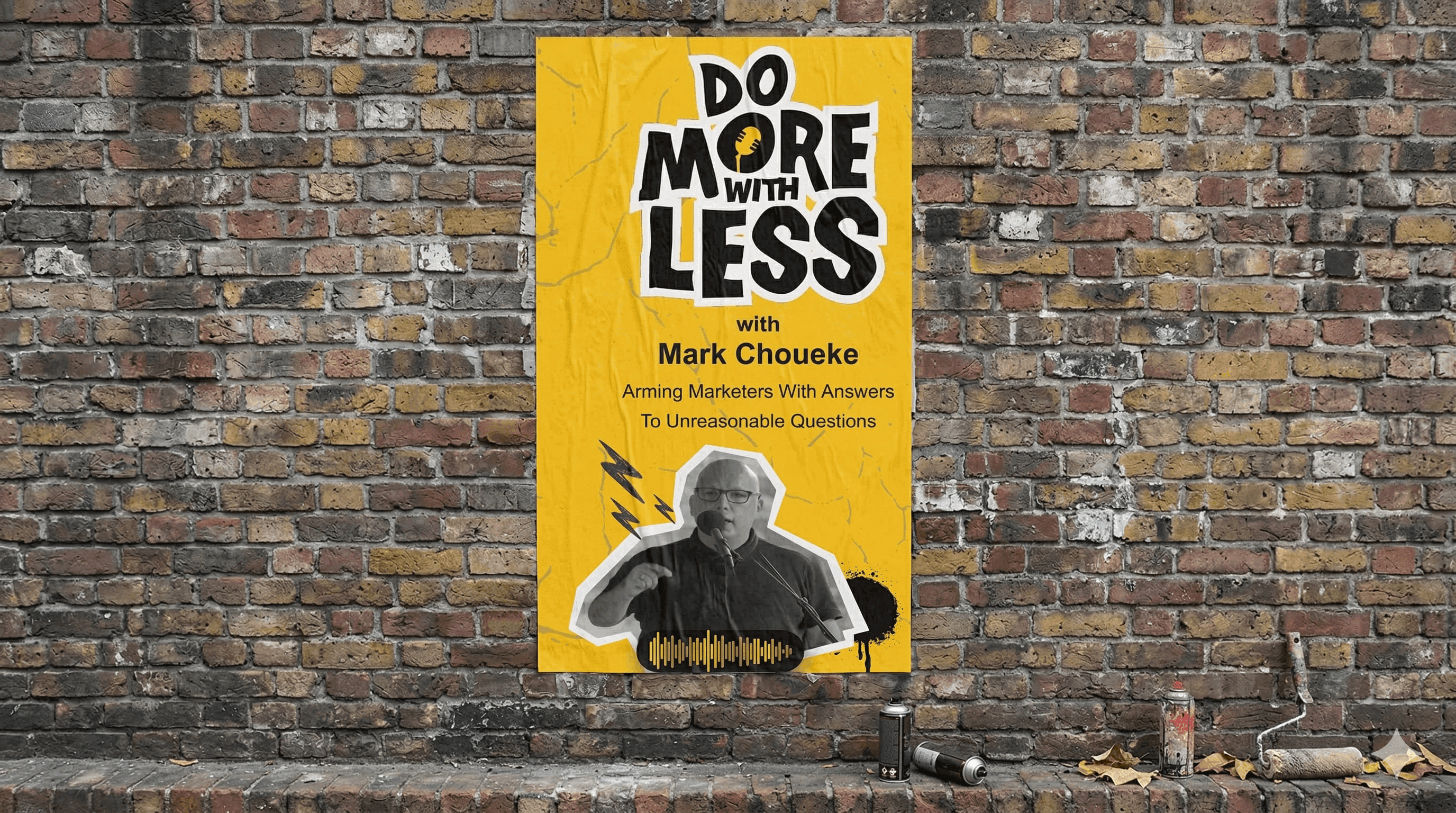

Everybody knows the phrase, "do more with less."
Especially if you follow the B2B Marketing United legend that is Mark Choueke, who has spent years unpacking what it really means and how marketers can navigate it.
It sometimes gets framed as a motivational challenge or a test of creativity, and although it's definitely not a challenge any marketer craves, it is a rite of passage.
The song I wrote, "Six Months to an Exit", dramatizes (and sends up) a familiar scene. A CMO with a growth plan, a grand vision, and dreams of building a brand-new category. And a board that listens, notes the spreadsheets, nods enthusiastically, and a few weeks later asks: can you just do the same as last year again? But with a flat budget. And still achieve our growth targets?
Private Equity firms are not buying companies to run them forever. Their model is very clear and very simple. They invest in companies to sell them for a profit. Ideally after a three-to-five-year cycle. Ideally sooner. Their job is to improve the valuation, and the cleanest lever for that is EBITDA to drive the exit multiple.
Revenue growth matters but not as much as margin. And predictability matters more than hope, leaving the next cycle of ambition to the next guys who own it.
None of this is irrational. It's the way it is. And the best marketing leaders mould what their team does and how they do it around these realities. Like all functions, marketing must always serve the company's strategy first.
Some marketers really struggle with this, as it's human nature to want to do more each year, and better than the last. Marketing evolves so fast that there is always more that we want to do. New tools we want to experiment with. New competitors we want to outdo.
And we struggle with the paradox often presented to us.
The CFO needs a growth story for the exit deck but is unable to put any more money in. They want that hockey stick but, at best, the spend needs to be flat.
This is where internal friction often begins. P&L owners are under immense pressure to deliver quarter by quarter. So, they protect their local budgets, resist central programs, and block spend that doesn't show immediate ROI.
It hurts those who don't quite understand the bigger picture. To some, it can feel like punishment, or torture.
Some functions become defensive. And sometimes, when incentives are misaligned or communication is poor, collaboration drops and political behaviour rises.
Things can get even harder if there's a bad quarter and a number is missed, as the CFO may need to claw more budget back whilst the pipeline still needs filling.
And the Head of Sales probably gets a bit nervous.
The selling firm wants a smooth story, a nicely trending prospectus, and an attractive multiple.
Sometimes management just want to survive the process to realize their Long-Term Incentive Plans.
Marketing, which lives in the long game, can sometimes feel a little squeezed in the middle, and as a profession, we have to adapt to the fact that any brand investment, new product launches, or modernization of infrastructure will probably have to wait until it's all over.
We have to work harder and smarter. Sometimes with delayed hires and less budget. And under more pressure. Rather than get depressed about it, the best marketing teams are pragmatic. They get it. There's something bigger going on and we need to play our role and help as much as possible.
We need to ensure the business keeps delivering. We need to step up and support from a PR & Comms perspective. I've supported multiple PE exits and been involved in IPO processes, including high pressure analyst presentations.
No matter how hard it gets for marketing, try being the CFO in this scenario.
In those situations where we are asked to deliver a hockey stick on a flat budget, the only response is communication and clarity.
Here is what we can deliver.
Here is what will stall.
Here is what we will be trading off.
Here is the risk we are taking.
The business can count on marketing to do whatever it can.
One thing we can also do is relish that next ownership cycle. New ownership is a fantastic opportunity to present an exciting investment case into the marketing function. Why? Because they want to drive sales growth and sell to someone else at an even higher valuation.
It's the way the world works.
Listen to Six Months to an Exit on Marketing Mixtape