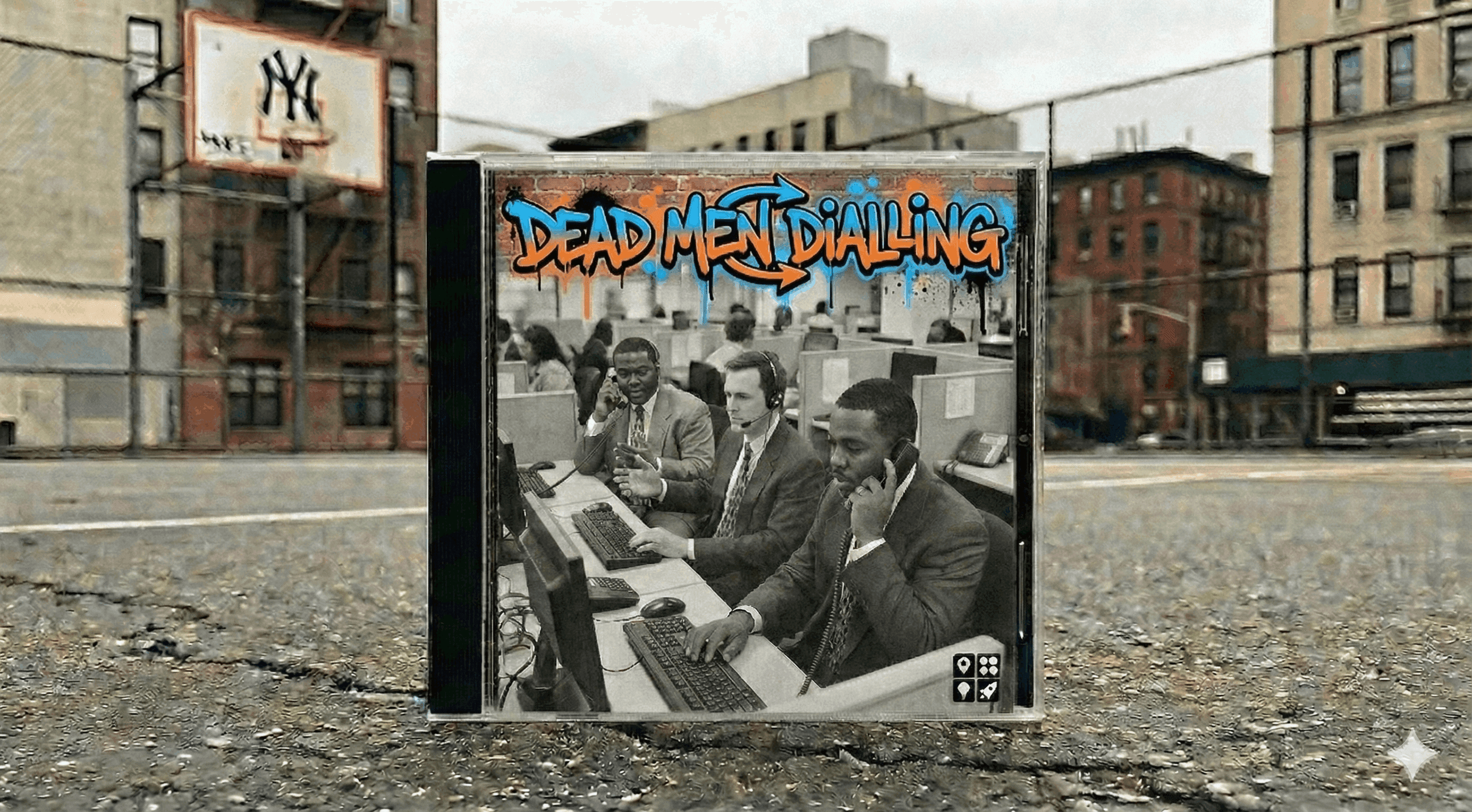

Last year I sat in a conference on B2B marketing and watched the opening keynote speaker declare cold calling dead.
You could feel the room shift. A few marketers rolled their eyes and audibly tutted. One CEO of an outbound SDR agency in the audience looked like they wanted to storm the stage. The speaker, who wasn't a marketer, had clearly hoped it was an easy remark to make. Or had been misadvised by ChatGPT when writing his speech.
That moment is how I wrote the song "Dead Men Dialling". My first attempt at gangster rap which is ambitious for someone who grew up in Essex and wears half zips. Listen below.
Because every time someone in B2B marketing declares a tactic dead, what they usually mean is that they have jumped on so many marketing bandwagons to curry favour, they are not thinking rationally or commercially. Direct mail is dead. Cold calling is dead. TV is dead. Events are dead. The funeral marches just keep coming, and they almost always arrive with a product pitch or agenda attached.
It is a cheap thing for anyone in our profession to claim. And it misses something fundamental about how attention actually works.
Three things that happened in the last few weeks
A sales rep I spoke to last week finally got a meeting after sending something physical to a prospect who had ignored every email for months.
A CMO of a large manufacturer told me their best lead of the quarter came from a chance conversation at a trade show and that they were doubling down on F2F events.
A SaaS founder said the deal that mattered most started with a mutual friend making a phone call to advocate for them and set up a dinner.
None of these tactics are coming back because they were misunderstood. They are resurfacing because the environment changed around them and they cut through the bullshit.
The economics of contrast
When something becomes easy, abundant and cheap for marketers, and non-marketers, it loses impact because the market is flooded and prospects become numb to it. When something becomes rarer and requires real effort, it starts to stand out. That is the whole game.
Look at what we are seeing right now. LinkedIn is an echo chamber of recycled thinking. Programmatic ads chase each other down the page. AI has turned "good enough" into a factory setting.
Volume is no longer an edge. And doing what everyone else does means being indistinguishable. Or average at best.
In that environment, anything that feels physical, human or effortful has a better chance at cutting through. Not because it is romantic or retro. Because effort is still the clearest signal of intent we have, and people notice when another human has actually bothered.
Numbers worth sitting with
A direct mail piece holds 132 seconds of attention. A TV ad holds around 14. An email, if you are lucky, holds whatever fraction of a second it takes to hit delete.
That is the whole argument in three numbers. The channels everyone keeps burying are the ones that earn the most time from the people on the other end of it. The 2025 ANA/DMA report puts direct mail response rates at 4.4% against email's 0.12%. Still incredibly poor in absolute terms, but the gap tells you everything you need to know about where attention is actually flowing.
Les Binet calls performance marketing on its own "underperformance marketing", because if it is the only thing you do, that is what it eventually becomes.
I think about that line a lot. Performance has not stopped working. It has just become a tax rather than an advantage. Costs rise, click-through rates barely move, and the pipes everyone is using start to look identical. Meanwhile, brand, memory, physical presence and human contact are quietly becoming the real sources of advantage again.
The SDR CEO who wanted to storm the stage already knew what the rest of the room is only starting to figure out. The tactics being pronounced dead are the ones quietly outperforming the ones being sold as their replacement.
The mistake was thinking technological progress meant replacement. It doesn't, it means rebalancing. Good marketers consider every tactic available to them and ignore what is, or is not, in fashion.
The best marketing plans I see are the ones that understand that we need to use everything in our arsenal to reinforce the same messages, across the same target audience, more often over a prolonged period of time. Not just the latest toys.
So, the next time someone tells you a channel is dead, ask yourself who benefits from the obituary. Then ask whether the thing they are burying might be exactly what helps you stand out. If your competitors are all doing A ,B, and C, give yourself the hypothesis that X, Y, Z might be the better direction.
It doesn't matter whether we like the tactics we use. It doesn't matter if they are cool or involve the latest AI tools.
It only matters if it works.
Now go and listen to an Essex boy attempt gangster rap.
Dead Men Dialling is the latest track from my Marketing Mixtape series at www.b2bmarketing.com