This is now one of the most common questions I hear from b2b marketers.
Not: How do I rank on Google?
Not: What keywords should we target?
But: Why does ChatGPT mention them and not us?
So let me answer it properly. As it currently stands.
In short
To appear in AI search results your company needs:
• Content that answers real questions clearly
• A distinct point of view repeated consistently
• Visibility in places AI already trusts
Why AI search changes the rules
Ask a question in ChatGPT, Google Gemini, Perplexity or Claude and something fundamental has changed.
You are not shown ten options. You are given one assembled answer.
If your company is not part of that answer you effectively do not exist in that moment. And that moment is now how buyers, especially the younger generation, increasingly conduct their research.
This isn't a prediction. It is already happening.
How AI search actually works
AI powered search tools do not rank pages in the traditional sense.
They generate answers based on patterns they have learned over time. Those patterns come from
Content that clearly answers questions
Sources that are cited repeatedly
Language that shows up consistently
Brands that demonstrate authority
So the goal is no longer to rank number one for a keyword, it is be the brand AI trusts when answering a question
That is what appearing in AI search results actually means.
A simple way to think about it
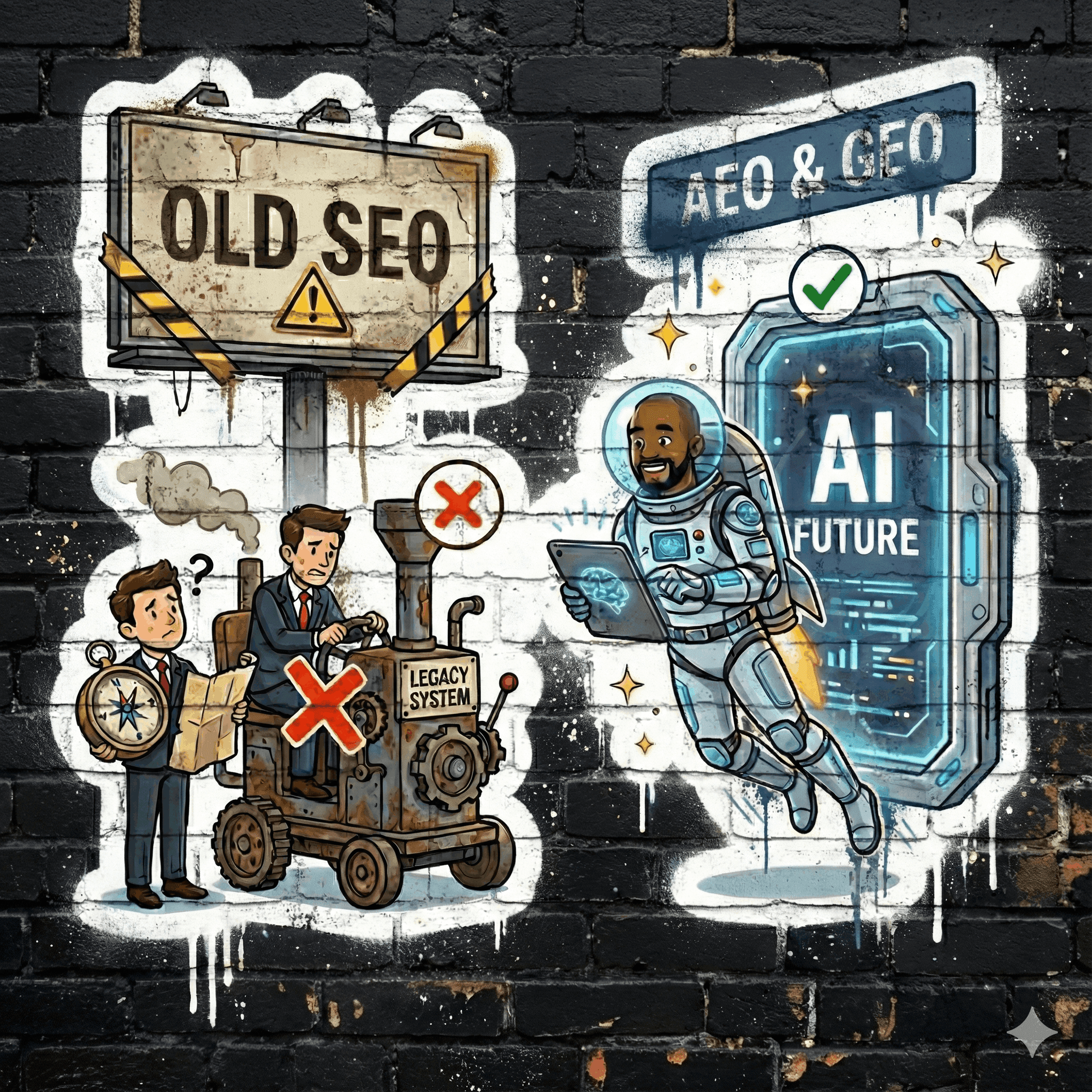
SEO was about being found.
AEO is about being quoted.
GEO is about being remembered.
And this is the line I want most marketers to sit with.
If you want to appear in AI answers you need to stop writing like you want to rank and start writing like you want to be understood.
And that's quite a shift in mindset.
Does SEO still matter
Yes. But not in the way most teams are still practising it.
SEO still matters because AI systems learn from the same web your content lives on. If your site is technically broken or invisible to search engines you will struggle to be visible to AI too.
But SEO is no longer the finish line. It is the entry fee.
Ranking pages without answering questions clearly will not help you appear in AI search results. Optimising keywords without a point of view will not get you quoted. Publishing more content without clarity will not make you memorable.
Think of SEO as the foundation.
AEO is how you get used.
GEO is how you get chosen.
What AEO really means
AEO stands for Answer Engine Optimisation.
In practice it is simple. You are making it easy for AI to lift a clean accurate answer from your content without guessing.
Content that performs well in AI search usually has
Headings written as real questions
Direct answers in plain language
Clear definitions without fluff
Examples that remove ambiguity
If your content exists to sound impressive AI struggles to use it. If it exists to explain something clearly, AI is far more likely to reference it.
AEO is how your company gets mentioned correctly rather than vaguely or not at all.
What GEO actually does
GEO stands for Generative Engine Optimisation.
This is where long term visibility is won or lost.
AI models learn through repetition. When the same language and framing appears again and again across credible sources it becomes the default explanation.
Try this yourself. Ask ChatGPT something like: What is the best Marketing Automation software?
You will notice the same companies appear repeatedly. That is not luck. It is clarity plus consistency over time.
If ten average sites describe a category the same way AI repeats it. But if one brand consistently explains it better and shows up often enough AI learns from that instead.
GEO rewards:
Distinct language
Clear opinions
Repeatable ideas
Consistency
This is brand building for AI search whether you like the term or not.
Where AI tools actually get their information
Despite the mystique AI does not magically know things.
ChatGPT, Gemini, Claude and Perplexity rely heavily on:
Credible editorial content
Recognised industry publications
Expert commentary and interviews
Clear explainer pages
Frequently cited sources
This is why being visible in the right places matters again. Being quoted matters again. Having named expertise matters again.
A ghost written CEO post is not a strategy.
How to actually make your company appear in AI search results
Before you worry about tools or tactics answer these honestly.
• Can we explain what we do in one clear paragraph?
• Do we answer real buyer questions directly?
• Do we use the same language everywhere?
• Are we quoted anywhere that matters?
Then do the work properly.
Start with the questions you want to be known for answering.
Not keyword lists. Real uncomfortable buyer questions.
Create definitive pages:
What is this
How does it work
When should you use it
When should you not
As b2b marketers, we will have to write to explain and not to impress as AI prefers clarity over creativity.
Get quoted elsewhere: PR and expert commentary now directly influence AI visibility.
Repeat yourself deliberately: Same language. Same framing. Same beliefs expressed consistently.
That is how generative AI tools learn.
The uncomfortable truth
There is no hack or quick fix despite what some of those Tik Tok influencers may try and tell you.
No plugin. No checklist. No shortcut.
If your company does not have a clear point of view AI will not invent one for you.
If your content is vague AI will look elsewhere.
If your brand is forgettable AI will move to someone else.
If AI cannot explain your company clearly that is not an AI problem, it's a problem for us as B2B marketers.
Call to action
If you are serious about showing up in AI search results start with the fundamentals.
Write down the three questions you want your company to be known for answering. Then read your website and content honestly.
If it does not answer those questions clearly neither will an AI.
Next, think in terms of measurable visibility not just content output. The brands that win with AI search can answer questions like:
• How likely is it that AI models recommend our brand over competitors?
• Where are we currently cited or mentioned and where are the gaps?
• How AI tools describe us and with what sentiment?
• How we perform across major generative systems including OpenAI, Gemini and Meta?
• How we stack up against competitors when AI answers buyer questions?
These are the signals AI systems use when deciding which brands to surface and suggest.
If you want help turning achieving all this then feel free to get in touch and we'll personally introduce you to the agencies that know their stuff.