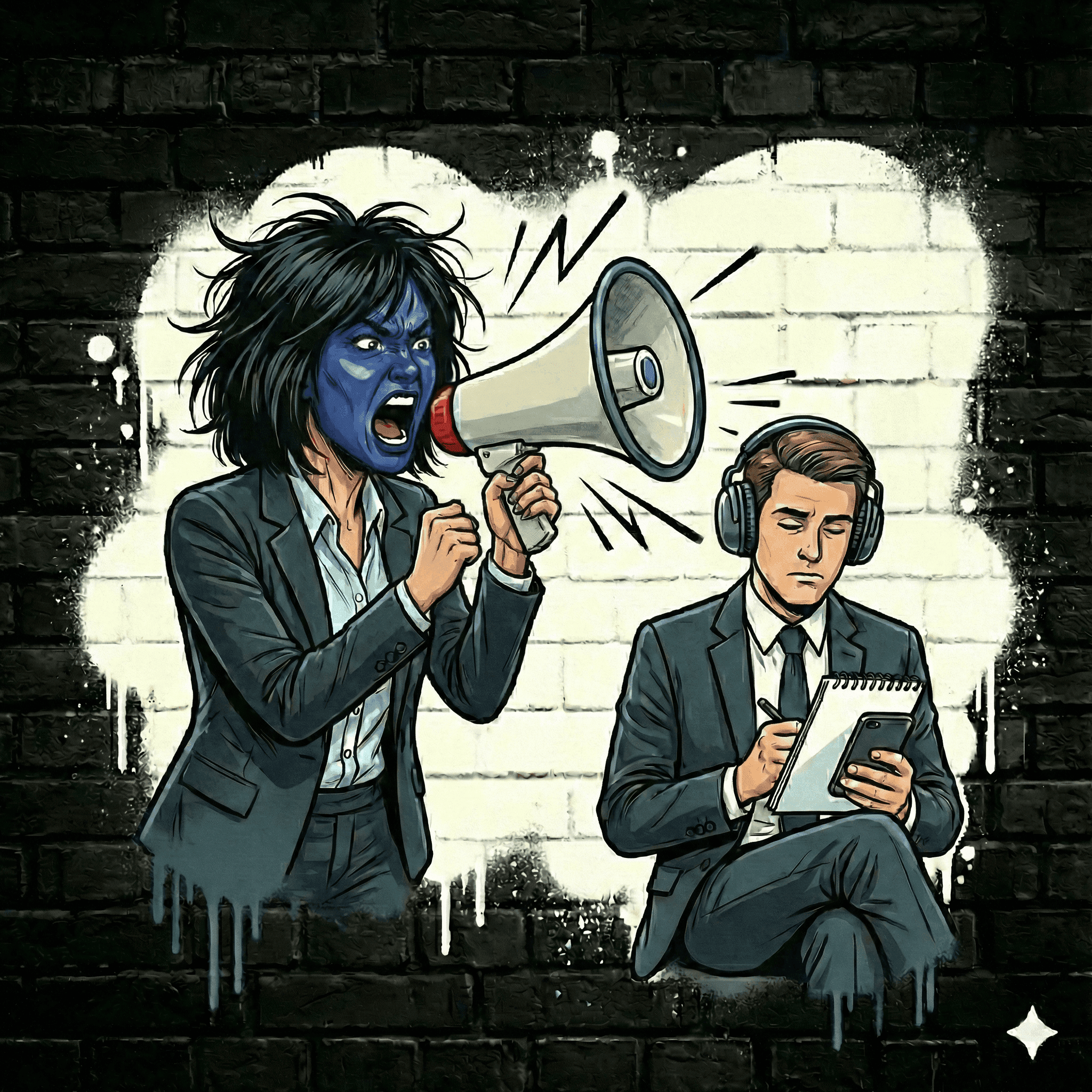
The lyrics of "Social Influenza" paint a dystopian picture of our modern condition: a feverish need for validation, a contagion of comparison, and the exhausting static of a life lived for the feed. The song warns of a sickness where we develop a craving for performance theater and an addiction to meaningless likes and comments.
For B2B marketers, LinkedIn is Ground Zero for this outbreak.
We are under constant pressure to optimize, to influence, and to "add value" until we are empty. The pressure to be a "Top Voice" can quickly mutate into a professional illness. This is the Social Influenza.
It starts with a slight fever of anxiety when you haven't posted in 24 hours and ends with full-blown Corporate Dysmorphia: the sickening gap between the human you are and the polished, hustle-culture avatar sufferers feel they need to present online.
If you find yourself posting "inspirational" stories about your morning coffee or using the phrase "delighted to announce" with a sinking feeling in your stomach, you may already be infected. If you want to survive the platform without losing your soul, you need to understand the pathology of the disease.
Here is your chart for diagnosis, treatment, and recovery.
Part I: The Pathology
The virus mutates quickly. In the B2B ward, we are currently seeing seven distinct variants of the influenza. You must learn to spot them in your feed, and, more importantly, in your own drafts.
Strain 1: The "Hustle Fever"
The Symptom: This is the inability to rest. You feel a burning compulsion to post seven days a week because "the algorithm demands consistency." You start measuring your self-worth by impression metrics rather than actual business conversations. You are burning up, generating heat but no light.
The Cure: Treat LinkedIn like a potent antibiotic, not a daily buffet. One or two insightful posts a week will always outperform seven days of empty noise. Your goal is resonance, not volume.
Strain 2: Buzzword Delirium
The Symptom: The virus attacks the language centers of the brain. You lose the ability to speak like a human. Suddenly, you aren't "solving problems"; you are "leveraging synergistic paradigms to unlock granular value adds." You are writing to sound smart, which inevitably makes you sound infected.
The Cure: Read your draft post out loud. If you wouldn't say those exact words to a friend at a bar (or a colleague over coffee) without getting laughed at, delete them. Write for humans, not for the "thought leader" persona.
Strain 3: The "Bro-etry" Spasms
The Symptom: This respiratory issue forces the writer to speak in short. Staccato. Sentences. You find yourself physically unable to write a paragraph. You break every sentence into its own line to "stop the scroll." You start posts with dramatic hooks like "I almost lost everything..." only to pivot into a banal tip about email open rates.
The Cure: Respect the Paragraph. Trust that your audience is intelligent enough to read three sentences grouped together. If your insight is actually valuable, you don't need to dress it up in the costume of a dramatic revelation.
Strain 4: Engagement Bait Nausea
The Symptom: You post polarizing or overly personal content solely to trigger the dopamine hit of the "comments" section. You ask questions you don't care about ("Agree?") just to boost the numbers. You feel a sinking sensation in your stomach because you know you are prioritizing the algorithm over your integrity.
The Cure: Intentionality. Before every post, ask: Does this actually help my prospect, or does it just feed my ego?If the answer is ego, keep it in the drafts. It is actually a very impressive trait to be able to talk yourself back from the ledge; it is not wasted time.
Strain 5: The "Tag-You’re-It" Rash
The Symptom: A highly contagious strain where the infected attempts to force the virus onto others. You finish a mediocre post and tag 30 people in the comments with the caption "Thoughts?" These people have no relation to the topic, but you need their "clout" to simulate a fever of engagement.
The Cure: Only tag someone if you are specifically quoting them or if you have a pre-existing relationship where they expect to be brought into the conversation. Do not sneeze on strangers to get their attention.
Strain 6: The "ChatGPT" Pallor
The Symptom: The infection takes over the brain completely, replacing independent thought with a gray, lifeless simulation. You stare at someone else’s post and realize you have nothing to say, so you generate a comment: "Great insights, [Name]! Synergy is indeed key." You become part of the perfect breeding ground for the virus to multiply and mutate.
The Cure: If you can't write a 50-word comment yourself, write a 5-word comment that is actually true. "This specific point resonates because" carries more weight than three paragraphs of AI slop.
Strain 7: Toxic Positivity Paralysis
The Symptom: The most dangerous strain, characterized by the inability to experience a human emotion without calculating its ROI. You suffer a personal tragedy, but before you can even process the grief, you are already mentally drafting the LinkedIn post about "resilience." You see your own life not as an experience to be lived, but as raw material to be mined for "lessons." You have become a content parasite on your own soul.
The Cure: Reclaim your humanity by refusing to monetize your suffering. Sometimes, a bad quarter is just a bad quarter, not a "failing forward" masterclass. Silence is an immune booster. It allows you to heal offline so you can return online as a person, not a carcass of content.
Strain 8: Circadian Grindset Syndrome
The Symptom: You jolt awake at 3:45 AM, cortisol spiking, convinced that if you sleep until 7:00 AM, you have already "lost" the day to your competitors. You drag yourself to the gym not for health, but to take a blurry photo of the squat rack or your watch face with the caption "Rise and Grind." You are sleep-deprived, hallucinating success, and mistaking exhaustion for dedication.
The Cure: High performance requires recovery, not deprivation. Unless you are training for the Olympics or operating a dairy farm, you do not need to be up at 4:00 AM. Sleep is a productivity tool. Your net worth is not tied to your alarm clock settings.
Part II: Building Immunity
The song lyrics speak to the desire to "escape" or "shut down." You likely cannot delete LinkedIn if it is your livelihood, but you can build a Hazmat suit to wear while you work.
1. Create a "Quarantine Zone" Social Influenza spreads when you let the platform dictate your schedule.
The Protocol: Turn off all LinkedIn notifications on your phone. All of them. Check the platform only during designated "work windows" (e.g., 9:00 AM to 9:30 AM). Do not let the virus follow you home to the dinner table.
2. Vaccinate with Reality The virus thrives on perfection. It dies in the face of reality.
The Protocol: Post about a failure. Not a "humble brag" failure (e.g., "I worked too hard and my team loved me for it"), but a real lesson learned from a mistake. Vulnerability is the antibody to the fake perfection of social influenza.
3. Mute the Super-Spreaders If a specific "influencer" makes you feel inadequate, annoyed, or tired, realize they are contagious.
The Protocol: Use the Mute button liberally. It is our best defense. You cannot heal in a toxic environment.
Part III: The Prognosis
To recover from the Social Influenza, you must remember the core sentiment of the song: You are not your feed.
In B2B, the most effective marketers are not the ones who have "gone viral" with a fever-dream of hashtags. They are the ones who remain healthy, grounded, and undeniably human.
The Final Prescription:
Stop "Networking," Start "Connecting": The influenza makes us view people as numbers (leads, likes, followers). Recover by viewing them as peers.
Check Your Pulse: Before you hit "Post," check your physical reaction. Do you cringe at the thought of posting it? If so, you are symptomatic.
Discharge: Close the tab. Go outside. Touch grass.
The static will always be there. You don't have to tune into it.
Listen to Social Influenza on the Marketing Mixtape