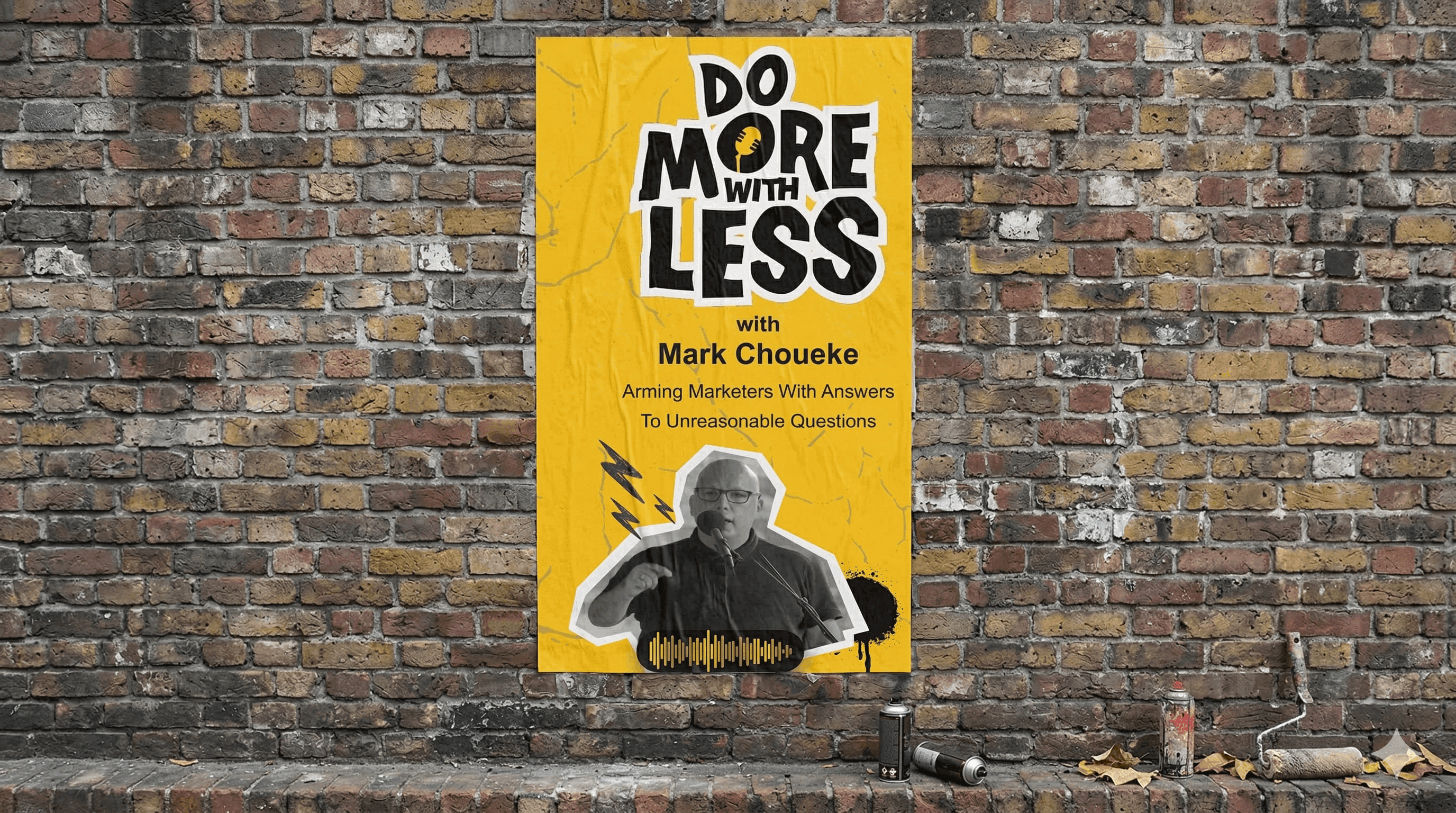

The 12 most consistent learnings from the first year of Do More With Less.
Twelve months ago I started a podcast for OrbitalX.com called Do More With Less.
Between myself and my colleague Stuart Dale, we’ve since interviewed more than 50 founders, CMOs, and revenue leaders all of whom have had to solve the same problem: how to keep delivering growth with ever-tighter resources and budget.
No guest pretended it was easy and no two guests had exactly the same approach to achieving their improbable success. But when you speak to enough smart people fighting against the same constraints, patterns appear.
Conversations spanned different types of companies and different industries. From the newest AI start-ups to multibillion-dollar enterprise businesses. But we’ve noticed enough of similar behaviours in response to budget shrinkage to draw some broad conclusions.
Here are the 12 most consistent lessons from the first year of Do More With Less.
1. Focus beats activity. Every time
The most repeated piece of advice from guests was brutally simple: stop doing so many things.
When budgets tighten, most teams instinctively try to maintain the same number of channels and campaigns with fewer resources, which rarely works.
Instead, Stan Garber, co-founder of Levelpath, argued teams should look to cover less surface area but with more depth; identify the two or three activities genuinely driving pipeline and double down on them.
Scattered activity only dilutes results and makes reporting harder and less convincing.
Practical takeaway:
Identify your three channels responsible for most pipeline
Pause or reduce everything else for one quarter - politely reject the inevitable requests for ‘more’ from the rest of your colleagues during this experiment
Reinvest all your time and energy in optimising the chosen three to the max
2. Imperfect marketing is an advantage
Greg Landon, VP of Marketing at SALESmanago, had one of my favourite takes when he said “perfect marketing is mostly a fantasy”.
Waiting for the perfect message, the perfect campaign or perfect creative usually means you end up shipping nothing at all.
And even when you do, you’ve been internally talking up your perfect campaign for so long, your colleagues and leadership have likely lost interest and mentally ‘moved on’. So by the time the creative is released, nobody else cares enough to support it.
Landon argued that teams working with tight resources have a huge advantage: “they can’t afford perfectionism”. I loved that.
Instead, they use speed as a growth lever; they test quickly, launch earlier and learn faster.
Practical takeaway:
Cut approval layers
Launch campaigns earlier
Optimise based on real market feedback
3. Constraints actually improve your thinking
Elena Pinakatt, former Global VP of Marketing & Transformation at Coca-Cola, made a fascinating observation.
Because constraints force better questions, even inside huge organisations like Coke, amazing ideas often emerge when budgets tighten or teams shrink.
When things get tight and you’ve less room in which to operate, you’re forced to examine assumptions; something you’ve rarely got time for but that is always a healthy exercise. I’m not saying a large budget always hides mediocre thinking, but if mediocre thinking exists, there’s nothing like scarcity to shine a light on it.
4. Relationships outperform tactics
One of the clearest and most emphatic assertions across our interviews is that relationships are a pretty infallible growth engine.
Several guests emphasised new efforts to be useful to partnerships, valuable to communities and known within trusted networks often produce better commercial results than traditional campaigns.
Michelle Meehan, CMO of Vetty, pointed out that B2B growth rarely comes from one brand acting alone, but through ecosystems. Relationships scale faster than advertising budgets.
It’s fairly obvious too that if your marketing idea comes with endorsement or participation from customers, partners or other industry voices, its credibility goes through the roof.
Practical takeaway:
Try mapping the five partners or creators who already influence your buyers
Figure out an approach that articulates the value for them of build content with you
Share audiences rather than trying to build everything yourself
5. Storytelling is still wildly underused in B2B
Meehan also championed another point that came up repeatedly: most B2B marketing is STILL painfully forgettable. Too many companies still believe that B2B buyers want purely rational communication - a bullet point list of features and packages.
They don’t. I’m not sure how many times I’ll have to say this again before I die but the moment you tell a significantly different story from your competitors; something bigger and bolder; maybe more visionary or even just more entertaining, your sales efforts will see 5X rewards almost immediately.
Elena Pinakatt echoed this from her Coca-Cola experience: emotion and narrative still drive attention like little else. Those of us willing to tell braver stories will see opportunities to outperform competitors with bigger budgets.
6. Systems beat heroic effort
Another theme that guests continuously hammered home throughout the year: doing more with less can’t rely on individual heroics; it needs systems.
Stan Garber talked about ‘repeatable processes that compound’ over time rather than launching endless one-off campaigns.
What could these repeatable processes look like in your real-life business week? That’s up to you. Look at what you’re doing and how it can be turned into a reliable system. Think ‘simple’ and think ‘leverage’...so good examples might be:
Figure out building a content engine rather than focusing on individual posts
What would it take to create repeatable webinars rather than one-off events?
How would partnerships become structured rather than ad-hoc collaborations?
7. Please…make your content work harder
The majority of our pod guests on Do More With Less mentioned - often in passing - that their marketing teams still produce content that only gets used once.
How mad is that? With restrictions and constraints everywhere, we’re busting our collective butts to produce brilliant stories and sales materials that we use once before consigning them to the dustbin.
As a marketer and storyteller, this drives me absolutely potty. If every great piece of marketing content you create is based on a fierce insight or compelling story, then consider it ‘elastic’. It can be stretched and moulded across countless different executions that can hit your different segments repeatedly without becoming ‘old’.
One interview becomes a podcast. The podcast becomes video clips. The video clips make for great social posts which are ripe for Linkedin but also serve as ammunition for outbound sales emails and pitch decks. They might also lead the agenda in an easily put together newsletter that then features a blog ‘written by’ your podcast host about their personal reflections of the interview. That blog could be pitched to the online trade publication read most often by your target ICP.
Or maybe the interviewer gathers the three most newsworthy examples or stories from the interview and repackages them into your next webinar; a webinar that should be promoted both before and after its broadcast - offered up to three times in the next 12 months as an on-demand asset in emails and on social. If it gets notable traction during that time then hire a venue, invite the original guest back to an in-person event and buy a crate of wine for 20-50 guests.
Every hour of good-enough content creation should feed your marketing machine for months
8. Proximity to customers matters more than dashboards
Data matters; every guest agreed as much. But several also warned about becoming overly dependent on dashboards. Leaders doing more with less told our community the best insights still come from customer calls, sales conversations and community discussions.
Elena Pinakatt described it as “detective work”. She said the closer marketers stay to real customer problems and the more questions they can personally ask face to face, sharper their insight and messaging becomes.
Haley Chute, chief product and marketing officer at Octagos, went further. “If you're not meeting your customers, you're probably not doing your job,” she said. “I could easily expect to personally meet a quarter per month.”
Where AI is dominating every conversation for good reason, Haley says ‘people are seeking what’s real’.
“We'll create real community spaces where we can have a conversation with them. We build trust - our strategy is ‘trust first and everything else second’. By doing that we’re able to use them to bounce ideas off or engage in product reviews or tell us how our message resonates.”
9. Small experiments make you go faster
Several of our guests on the pod described the freedom they felt in moving away from large, expensive campaigns and instead running smaller, faster experiments.
Even large organisations, they said, are benefiting from testing messaging through LinkedIn posts, launching small pilot events or trialling new content formats quickly with no expectations except to learn something. Such an approach often doesn’t need to be reported at the highest levels unless you derive something good from it - the risk you run remains small while you and the team increase the speed of learning in a new and tough trading environment.
10. Doing more with less needs clarity
Doing more with less is rarely about working harder but about clarity.
If there is even slightly blurred thinking regarding who your audience really is, what problem you solve for your clients, which channels actually work or which activities can stop without slowing momentum, you’re skirting on the edge of trouble.
Have answers to the big questions locked down, fully front of mind and communicated across all adjacent functions and you’re in a good place. It reduces risk and workload if everyone across the business is playing to win the same game.
11. Think beyond marketing
Jennifer Shaw-Sweet, the global practice lead for the B2B Institute at LinkedIn, urged our listeners to double down on earning a reputation as truly commercial operators. Regardless of your seniority, make sure you’re 100% fluent in the factors that win and lose your business deals; how the business makes money, what drives pipeline and which of your activities actually influence revenue.
It sounds obvious but it’s still surprisingly rare for marketers to talk in terms of revenue and pipeline as opposed to marketing outputs. We earn influence when we demonstrate impact over outcomes.
12. Lean in to leadership
After recording dozens of Do More With Less episodes, I can honestly say the one thing I think is most clear is this. Whatever age you are and again, regardless of your level of experience, start thinking of yourself as a leader.
If you only see, think about and talk about tactics, you’ll make yourself irrelevant. The past year’s collection of Do More With Less podcast episodes has, in effect, been one extended discussion on how marketing leadership itself is changing.
The marketers thriving right now share several characteristics: they think commercially, they challenge all assumptions including their own, they prioritise ruthlessly, they stay close to customers and they think relentlessly about value and impact.
And most of all, they accept that doing more with less is not a temporary phase to ‘get through’.
It’s a correction; the new and permanent operating environment.